Germany's Investment in KNDS: A Strategic Defense Move
The German government has announced its intention to purchase a 40% share in KNDS, a prominent European tank manufacturing company. This acquisition, which aims to match the French government's current stake, is seen as a pivotal step towards solidifying Germany's influence within the critical defense sector and reinforcing the Franco-German relationship. The deal is also expected to pave the way for KNDS's long-anticipated initial public offering (IPO).
Reports indicate that the stake could be valued at approximately €6 billion ($6.8 billion), contingent on the company's final valuation. The transaction awaits approval from the budget committee of the German Bundestag. Currently, France holds a 50% ownership of KNDS. A joint statement from both nations confirmed an agreement on the company's "strategy and governance," with a shared goal of maintaining equal shareholding levels in the future. Media outlets, citing sources close to the negotiations, suggest that France plans to reduce its stake to 40% to achieve parity with Germany. The remaining 20% is anticipated to be offered in the IPO, which will list on both the Frankfurt and Paris stock exchanges.
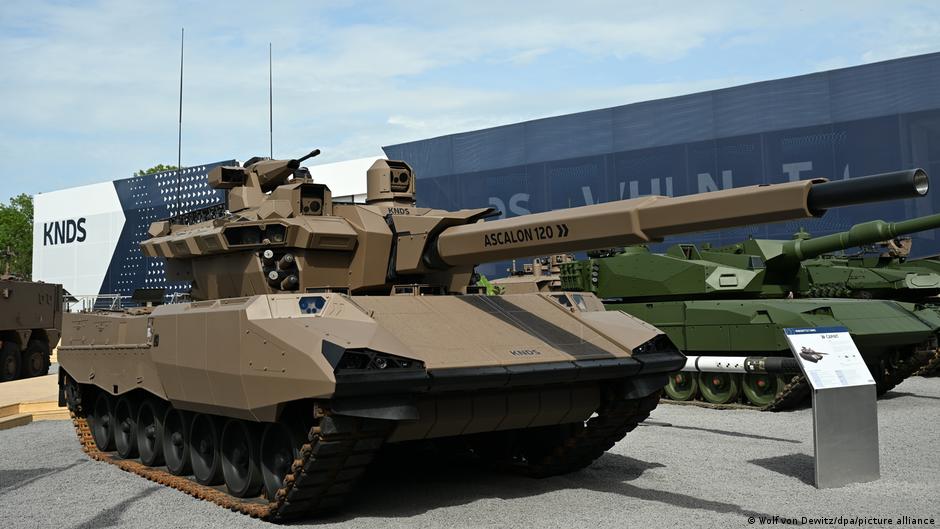
Germany's decision to act follows a move by Wegmann & Co, a holding company representing the families who partly own KNDS, to sell their shares. KNDS, recognized as Europe's largest tank manufacturer, is responsible for producing the German Leopard 2 and French Leclerc battle tanks. The company is also actively involved in developing the next-generation Main Ground Combat System. KNDS was established in 2015 through the merger of Krauss-Maffei Wegmann, a German family-owned firm, and Nexter, a French government-owned weapons manufacturer.
Stefan Kornelius, spokesperson for the German government, emphasized that the deal's primary objective is to "safeguard federal interests." He further stated that "Germany's participation in KNDS will secure long-term influence over a company that is strategically important for European security and defense capabilities." The joint statement from the French and German governments articulated a clear ambition: "to develop KNDS into a leading European and global defense company serving the French and German armed forces."
A Broader Trend: Government Control in Defense
This recent development with KNDS is not an isolated incident; it aligns with a growing trend of the German government directly investing in major defense companies. Marco Becht, a professor of corporate governance at ULB University in Brussels, observed that Germany has historically maintained fewer direct stakes in companies compared to other European nations. However, he believes this deal signifies Berlin's dual desire to capitalize on potential future earnings and exert greater strategic control within the increasingly vital defense sector.
Becht remarked, "They think: Why do we leave all the money to be made to private investors? And why is the state not making money from these companies through being a shareholder?" Declan Power, a defense and security analyst at the Institute for International and European Affairs, underscored the deal's significance, particularly as a testament to France and Germany's strong commitment to enhancing their defense capabilities. "Europe does a lot of talking about it, but this deal is a tangible step towards Europe taking control of its own defense manufacturing capabilities," Power told DW, advocating for more direct governmental control over defense companies. He highlighted that "The essence of the responsibility of a state, particularly a democratic state, is the protection of its territory and its people."
The German government's statement also underscored the heightened importance of defense in Europe following Russia's full-scale invasion of Ukraine in 2022, noting that "This geopolitical situation necessitates an expansion of defense industry capacities." Becht suggested that this situation also drives a push for increased control. While the government already wields considerable influence over the sector through the War Weapons Control Act, which governs licensing for weapons production and sales, this influence does not always extend to direct corporate involvement. The KNDS deal, alongside others, indicates a potential shift in this dynamic.
For instance, when submarine builder Thyssenkrupp Marine Systems went public in October 2025, the German government secured special advisory rights and supervisory board nomination rights as part of the IPO. Similarly, in 2021, the state-owned KfW bank acquired a 25.1% stake in military radar company Hensoldt. Furthermore, the German state holds approximately 11% of shares in aerospace and defense giant Airbus. "If you look at these cases, the German state does seem to take more of an interest in the defense sector and wants to be more involved," Becht concluded.
Franco-German Relations: An Equal Footing
Beyond Germany's individual defense aspirations, the KNDS agreement holds considerable weight for the bilateral Franco-German defense relationship. This deal follows the collapse of the FCAS fighter jet project, a long-planned Franco-German defense collaboration that ultimately failed due to disagreements between Airbus's German wing and France's Dassault over project control. The termination of that agreement hinted at underlying tensions in the Franco-German relationship, which is crucial for Europe's collective defense sovereignty. The extended duration of the KNDS negotiations also suggested challenging discussions.
Germany's statement emphasized the importance of close collaboration with France, asserting that the deal "aims to strengthen bilateral and European defense cooperation in particular, with collaboration with France playing a key role." It further stressed a commitment to working "in close dialogue and on an equal footing with its French partners."
Analyst Declan Power believes that France has historically tended to seek a dominant position in its defense relationship with Germany. "I think their natural reflex action is always to try and hold a dominant position," he stated. However, he posited that the Franco-German defense relationship could thrive through more substantive industrial collaboration, such as that demonstrated by the KNDS deal. "When you bring industry into it and you have German and French industry collaborating at the coalface, then I think that will improve the mechanism," Power explained. Conversely, ULB professor Becht argued that from Germany's perspective, the deal is as much about asserting its burgeoning defense strength to France as it is about collaboration. "It shows a new German willingness to be more assertive and to do fewer favors," he commented. "Germany is increasingly prepared to say 'No', rather than agreeing to something simply to accommodate France."
Source: Original Article