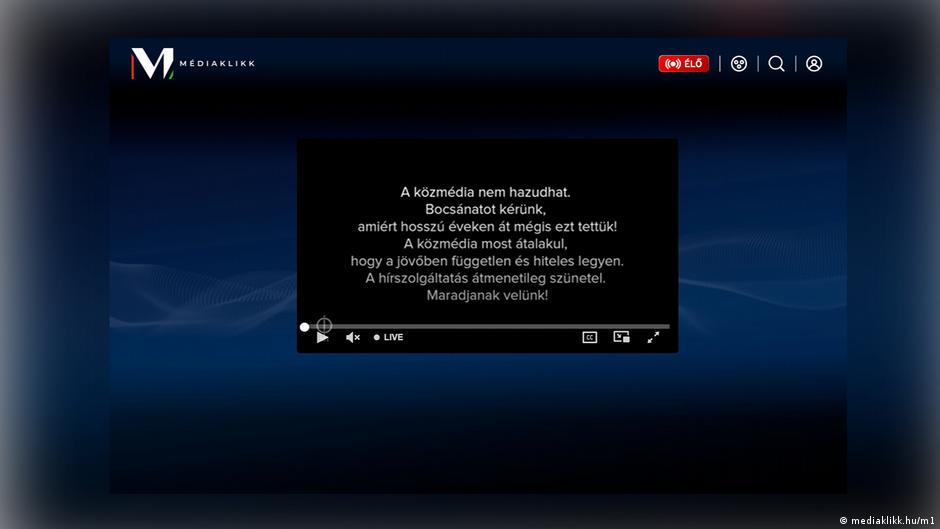
A New Era for Hungarian Public Media
On Tuesday, viewers tuning into Hungary's public service media were met with an unexpected sight: a black screen accompanied by an apology. This event signaled the beginning of a substantial overhaul of the nation's state-run broadcasters, a process initiated by Hungarian Prime Minister Peter Magyar. The move aims to dismantle what has been described as a potent instrument of power under the previous administration.
For nearly four hours, the Hungarian television channel M1 ceased regular broadcasting, instead displaying a message that read: "Public media should not lie. We are sorry for doing it for so long. Public media will now be reformed so they will be independent and trustworthy. Our news service is currently suspended. Stay tuned!" This apology and announcement replaced all news bulletins and political programs across Hungary's public television and radio channels. Only the website of the news agency MTI, also part of the public media holding MTVA, continued to publish political news.
Addressing a Legacy of Disinformation
The disinformation disseminated by Hungarian public service media during Viktor Orban's 16-year tenure has been described as unique within the European Union. Critics argue that no other EU public broadcaster in recent decades engaged in the spread of lies, hate, and propaganda on such a scale. Some content has been likened to fascist and antisemitic propaganda from the interwar period, while other narratives reportedly mirrored those found in Russian state media.
Examples of past narratives include depictions of Arab and African migrants as criminals, a US billionaire of Jewish-Hungarian heritage as a threat to Hungary's Christian identity, and the EU's alleged indoctrination of children with "LGBTQ propaganda." Furthermore, the media reportedly portrayed Ukraine as a "mafia state" intending to sacrifice Hungary's youth in conflict and defraud Hungarian pensioners.
A “Historic Day” for Hungary
Prime Minister Peter Magyar heralded the changes on Facebook, stating, "Today marks the end of propaganda broadcasts on public media platforms." He added, "They lied at night, they lied during the day, they lied on every wavelength. That is now over." This event is considered a watershed moment for Hungary, unprecedented even in the transition from communism to democracy in 1989/90.
Beyond the symbolic black screen, tangible changes have been implemented. Key figures at M1, including its director Zsolt Nemeth (known as "Pitbull" for his confrontational style), and most senior programming directors and news editors, have been removed from their positions.
Symbolic Timing and Content
M1 resumed broadcasting precisely at 7:56 p.m., a choice of time (19:56 CET) that was deliberately symbolic. It referenced the anti-Communist, anti-Soviet revolution of 1956, which was brutally suppressed by Soviet forces. The subsequent film broadcast, "The Witness," a 1979 Hungarian political satire about the absurd propaganda and horrors of Stalinism, further underscored the message of the reform. The black screen with the apology remains visible on the website of Hirado, M1's main news program.
Fulfilling a Campaign Promise
The radical restructuring of Hungary's public service media was a central pledge in Peter Magyar's election campaign. Following his Tisza party's significant victory, Magyar consistently criticized public service broadcasters, labeling them a "factory of lies." The reforms address a period during which the previous government, led by Viktor Orban, reshaped Hungary's public and much of its privately-owned media to align with its agenda.
Soon after his 2010 election win, Orban's government revised media legislation, established the National Media and Infocommunications Authority (NMHH), and appointed pro-government figures to key regulatory bodies. Public service media were then centralized under the MTVA holding company. By 2011, many independent journalists had either been dismissed or voluntarily left public media outlets.
The Erosion of Balanced Reporting
From that point, the term "public service media" became largely nominal. MTVA's outlets increasingly functioned as a mouthpiece, reiterating government narratives. M1's news and political programs frequently targeted the EU, investor George Soros, civil society organizations, and independent journalists. Despite legal obligations for balanced reporting, opposition politicians and independent voices were largely absent from MTVA channels. Following Russia's 2022 invasion of Ukraine, MTVA channels intensified their rhetoric, presenting a narrative that portrayed Ukraine negatively and, at times, echoed Russian state propaganda.
A similar approach was applied to private media, with government-aligned oligarchs acquiring outlets and either bringing them into line or shutting them down, as seen with the left-wing daily Nepszabadsag in 2016. In 2018, business figures close to Orban transferred their media assets to the Central European Press and Media Foundation (KESMA), encompassing hundreds of broadcast, print, and online outlets within the pro-government private media sector.
The Path Forward
A transitional director was appointed at the MTVA media holding company last week, who subsequently named an interim leadership team for M1. MTVA has stated that permanent leadership positions will be filled through a public selection process involving social and professional organizations. Independent journalists have largely welcomed these changes, advocating for genuine participation in the reform process and awaiting further details of the government's plans. The proposed structure for the supervisory board of the restructured media holding company includes three representatives each from the government majority, the parliamentary opposition, and independent journalists' associations.
The reform has drawn criticism, with former Prime Minister Viktor Orban describing it as "a new step in the Tisza Party's tyranny." Opposition lawmaker Balazs Nemeth, a former Hirado news anchor, also voiced disapproval, stating on Facebook after M1's screen went black, "Hungarian democracy is dead."
Source: Original Article