
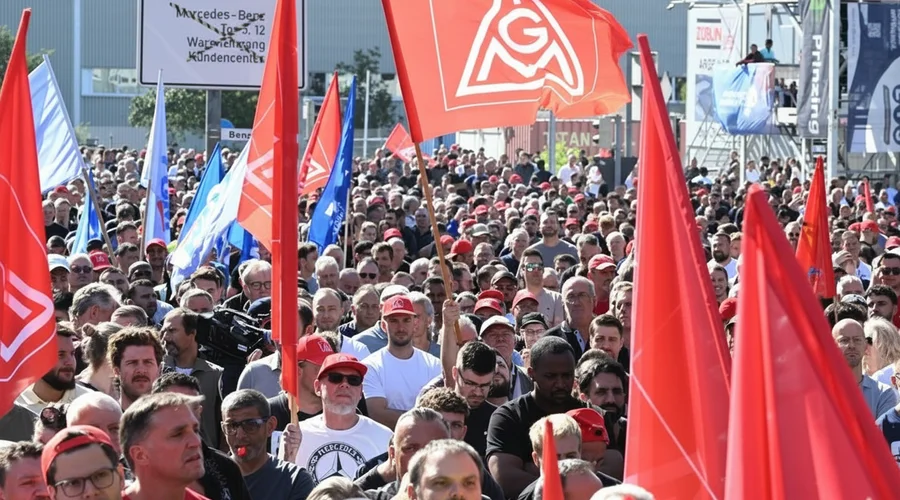
Widespread Discontent Among Mercedes-Benz Workforce
Employees of the renowned German automotive manufacturer, Mercedes-Benz, have commenced a series of demonstrations throughout the country, voicing strong opposition to the company's ongoing cost-cutting initiatives. The protests, which have seen thousands participate, underscore a growing tension between the workforce and management regarding the future direction of the enterprise and its implications for job security and employee benefits. The actions highlight a significant moment of industrial relations in Germany's crucial automotive sector, as a leading global brand navigates economic pressures and the demands of its labor force.
The core of the workers' grievances appears to stem from anxieties that these cost-cutting measures could lead to job reductions, shifts in production locations, or a deterioration of established working conditions. Union representatives and employee councils have reportedly been in discussions with company leadership, but the scale of the protests suggests that these dialogues have yet to fully alleviate the concerns of a substantial portion of the workforce. The demonstrations are not isolated incidents but rather coordinated efforts across various Mercedes-Benz facilities, indicating a unified front among employees.
Economic Pressures and Corporate Strategy
Mercedes-Benz, like many global automotive giants, is operating in a rapidly evolving market characterized by increasing competition, the transition to electric vehicles, and broader economic uncertainties. Companies often implement cost-cutting strategies to maintain profitability, invest in new technologies, and remain competitive. However, such measures frequently encounter resistance from employees who fear bearing the brunt of these changes.
The automotive industry is a cornerstone of the German economy, employing hundreds of thousands directly and indirectly. Decisions made by major players like Mercedes-Benz have far-reaching implications, not only for their immediate workforce but also for supply chains, local economies, and national employment figures. The current protests therefore carry a significance beyond the confines of the company itself, reflecting broader debates about industrial policy, labor rights, and corporate responsibility in a globalized economy.
Union Involvement and Collective Bargaining
German labor law and the strong tradition of collective bargaining mean that trade unions play a pivotal role in representing workers' interests. In this context, unions are likely to be at the forefront of negotiations with Mercedes-Benz management, seeking to mitigate the adverse effects of any cost-cutting programs on their members. The protests serve as a powerful tool for unions to demonstrate the collective resolve of their members and to strengthen their position at the bargaining table.
Historically, German industrial relations have emphasized cooperation and consensus-building, often through works councils and co-determination principles. However, when significant disagreements arise over strategic decisions that impact employment, more confrontational approaches, such as strikes and protests, can emerge. The current situation at Mercedes-Benz could test the limits of these established mechanisms, highlighting the challenges of balancing corporate objectives with employee welfare.
Potential Outcomes and Future Outlook
The outcome of these protests and subsequent negotiations will be closely watched by various stakeholders, including other industrial companies, labor organizations, and government officials. A resolution could involve a compromise where Mercedes-Benz adjusts its cost-cutting plans, potentially by offering job security guarantees, retraining programs, or alternative employment opportunities for affected workers. Conversely, a failure to reach an agreement could lead to prolonged industrial action, potentially impacting production and the company's financial performance.
The automotive sector's ongoing transformation towards electric mobility and digitalization also adds another layer of complexity. While these changes promise new opportunities, they also necessitate significant restructuring, which can be a source of anxiety for a workforce accustomed to traditional manufacturing processes. Addressing these concerns effectively will be crucial for Mercedes-Benz to ensure a smooth transition and maintain employee morale and productivity.
The current wave of protests at Mercedes-Benz facilities across Germany serves as a stark reminder of the ongoing tension between corporate efficiency drives and the protection of labor interests. The manner in which this situation evolves will undoubtedly set a precedent for future industrial relations within Germany's vital automotive industry.
Source: Original Article