
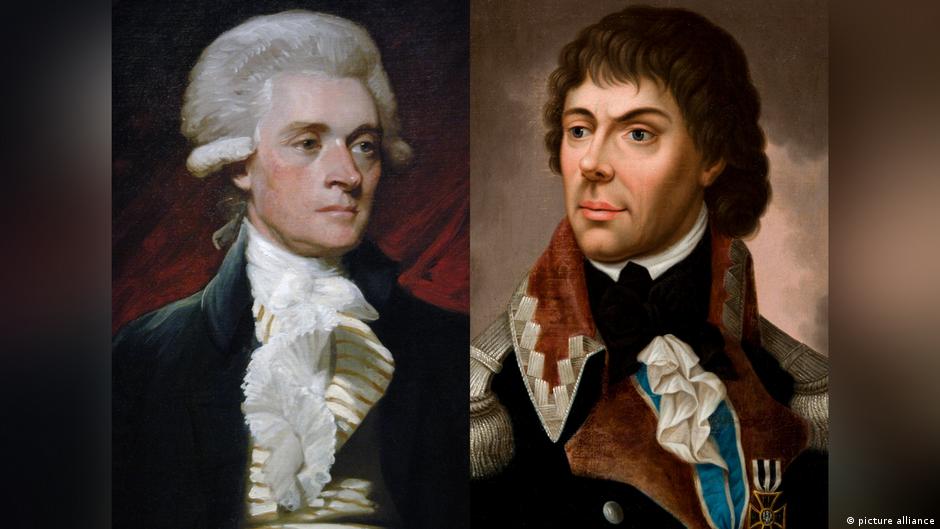
The Unfolding Legacy of Thomas Jefferson
Thomas Jefferson, a pivotal figure in American history, stands as the principal author of the Declaration of Independence and the third President of the United States. His image is etched into the American consciousness, from the bronze statues in Washington D.C. to the monumental carvings of Mount Rushmore. A lawyer, plantation owner, and politician, Jefferson's career included serving as the first Secretary of State and second Vice President before his presidency, during which he oversaw the significant Louisiana Purchase, nearly doubling the young nation's size.
However, like many historical figures, Jefferson's legacy is complex and has faced increasing scrutiny in recent decades. This re-evaluation often centers on his personal actions and their alignment with the ideals of liberty and equality he so eloquently articulated. A critical episode in this re-examination involves his relationship with Tadeusz Kościuszko, a Polish military engineer and freedom fighter who played a crucial role in the American Revolutionary War.
Tadeusz Kościuszko: A Champion of Universal Liberty
Tadeusz Kościuszko, whose name graces numerous streets and landmarks across the United States, was a staunch advocate for universal freedom and equality. After making a name for himself as a talented military engineer in the American War of Independence, he returned to Europe, leading a failed uprising against Tsarist Russia in 1794. Following his imprisonment and subsequent release, Kościuszko traveled to Philadelphia, then the U.S. capital, in 1797.
It was during this period that his friendship with Jefferson deepened. Jefferson, by then the Vice President, held Kościuszko in high regard, describing him in a letter to another general as "as pure a son of liberty as I have ever known, and of that liberty which is to go to all, and not to the few or rich alone." This mutual respect set the stage for a profound moral challenge that would test Jefferson's commitment to these very ideals.
Kościuszko's Moral Test: A Will for Freedom
In 1798, as Kościuszko prepared to leave America permanently, he entrusted Jefferson with an extraordinary request. He designated Jefferson as the executor of his American estate, stipulating that the funds be used after his death to purchase freedom and provide education for Jefferson's enslaved people. Kościuszko, a fervent opponent of both serfdom and slavery, had consistently demonstrated his principles, notably by choosing a Black soldier as his adjutant during his service in the American army. This directive from Kościuszko posed a direct challenge to Jefferson, an enslaver himself, to act upon the principles of liberty that both men ostensibly championed.
Historians continue to debate the intent behind Kościuszko's request. Was it a subtle rebuke, an attempt to shame his American friend into action, or merely a reminder of the foundational American ideals for which Kościuszko had risked his life? Regardless of the specific motivation, the will represented a clear moral imperative.
The Unfulfilled Promise
Kościuszko passed away in Switzerland in 1817. Two years later, in May 1819, Jefferson appeared before a Virginia court concerning the will. Despite having reassured Kościuszko in 1810 that he would honor his wishes, Jefferson declared himself unable to execute the will and requested the court appoint another executor. This decision, and the subsequent failure to carry out Kościuszko's instructions, led to decades of legal disputes. It wasn't until 1852 that the U.S. Supreme Court finally awarded Kościuszko's estate to his European heirs, leaving his original intent unfulfilled.
This episode has become a significant point of discussion for American historians. Coupled with revelations about Jefferson's long-term relationship with his enslaved woman, Sally Hemmings, the failure to execute Kościuszko's will further complicates the narrative surrounding the founding father's commitment to the principles of freedom and equality.
Historical Interpretations and Debates
Biographer Henry Wiencek, author of Master of the Mountain: Thomas Jefferson and His Slaves, argues that Jefferson's reluctance stemmed from a desire to maintain his luxurious lifestyle and status within the slaveholding elite. Wiencek suggests that freeing his enslaved people, as Kościuszko's will intended, would have been economically detrimental and socially disruptive for Jefferson.
Conversely, Harvard law professor Annette Gordon-Reed offers a different perspective, highlighting the legal complexities of Jefferson's position. She notes that Kościuszko had drafted other wills in Europe after leaving the U.S., which could have created legal ambiguities. Gordon-Reed also points out that Jefferson was 75 years old at the time and may have been disinclined to engage in what promised to be protracted litigation.
However, journalist and historian Alex Storozynski, an expert on Kościuszko, views the existence of other wills as merely a convenient excuse for Jefferson. Storozynski contends that executing Kościuszko's wishes would have positioned Jefferson at the forefront of the burgeoning abolitionist movement, a role he ultimately shied away from, perhaps due to the profound societal and political implications it would entail, potentially foreshadowing the American Civil War.
A Legacy of Contradictions
Today, a statue of Tadeusz Kościuszko stands in Washington D.C.'s Lafayette Square, depicting him in his American officer's uniform, holding plans for the military fortifications that aided the American victory. From his pedestal, he gazes towards the White House, where his friend Jefferson was the first resident. The serious expression on Kościuszko's face, as author Wiencek suggests, might be seen as ironic. When measured by their unwavering commitment to the ideals of universal liberty and equality, some historians argue that the Polish military man, Kościuszko, ultimately embodied a greater 'American' spirit than the founding father, Thomas Jefferson, himself.
Source: The moral test US founding father Thomas Jefferson failed?