Unprecedented Financial Gains for a Former President
Donald Trump's financial disclosure report for his first year out of office reveals earnings of at least $2.2 billion, a figure historians consider unparalleled among former US presidents. This sum has intensified the ongoing discussion surrounding potential financial conflicts of interest for presidents and their families.
Historically, presidents have largely distanced themselves from business dealings while in office to uphold the integrity of the presidency. For example, Harry Truman left the White House with only his Army pension. George W. Bush placed his investments in a blind trust before his presidency, stating he was unaware of the impact the 2008 economic crisis had on his net worth.
The Scope of Trump's Recent Earnings
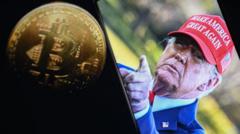
A substantial portion of Trump's reported earnings, approximately $1.4 billion, originated from the cryptocurrency industry. This includes $635 million in royalties from Celebration Coins, linked to the $TRUMP meme coin launched just before his second term. Additionally, over $500 million was reported from World Liberty Financial, a cryptocurrency firm reportedly founded by his sons, Donald Trump Jr. and Eric Trump, alongside the sons of Steve Witkoff, a special envoy during Trump's administration.
These 2025 earnings represent a significant increase, nearly four times the $622 million reported in 2024, the year before his return to office.
Reactions and Historical Context
Presidential historian Barbara Perry of the University of Virginia's Miller Center noted, "There's just no precedent for this. It's beyond anything we've ever seen in the presidency." Critics argue that these ventures blur the lines between official government policy-making and private business interests involving the president, his family, and close advisors.
The White House has denied any conflicts of interest, with Deputy Press Secretary Anna Kelly stating, "Neither the President nor his family has ever engaged - or will ever engage - in conflicts of interest." She further asserted that actions by the administration are in the best interest of the American people.
While past administrations have faced financial scandals, such as the Teapot Dome scandal during Warren Harding's presidency, these typically involved officials rather than the president directly enriching themselves. Similarly, relatives of modern-era presidents, like Jimmy Carter's brother or Joe Biden's son, have been involved in business ventures. However, historians generally agree that the scale of Trump's and his family's profits surpasses these previous examples.
Ethics and Business Practices
Before his first term, Trump handed control of the Trump Organization to his adult sons, but did not place his business interests in a blind trust or divest from his holdings, departing from past presidential norms. Similar arrangements were made before his second term, with the Trump Organization stating he would not be involved in day-to-day operations.
However, actions taken during his time in office have drawn scrutiny. For instance, legislation supporting stablecoins was signed four months after World Liberty Financial launched its digital currency venture. Additionally, the pardon of Binance founder Changpeng Zhao occurred as Trump publicly praised the crypto industry, a shift from his previous skepticism.
Beyond cryptocurrency, Trump's family business and associates have reportedly benefited in other sectors. A deal with Kazakhstan involving critical minerals, which saw Eric Trump and Donald Trump Jr. acquire a minority stake, and the involvement of an investment firm run by the sons of Commerce Secretary Howard Lutnick, have also raised questions.
Trump has attributed his profits to stock market gains, stating he is not involved in his personal finances, which are managed by funds. However, ethics watchdogs, including Richard Painter, former chief White House ethics lawyer under George W. Bush, view the situation as a significant conflict of interest. "This is a very, very troubling situation for the American people to see their president making so much money from the presidency," Painter commented.
Source: Original Article