
Remembering a Disco Icon
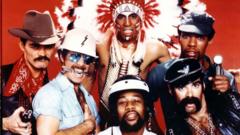
Victor Willis, the distinctive lead vocalist and co-creator of many hit songs for the 1970s disco sensation Village People, has passed away at 74. The announcement was made via the band's official social media on Monday, June 30, 2026, citing a brief but aggressive illness.
Willis, a Texas native, was instrumental in crafting and performing some of the group's most enduring tracks, including 'YMCA,' 'Go West,' and 'In The Navy.' The Village People rose to international fame in the 70s, characterized by their members dressing as various archetypal masculine figures. Willis himself famously portrayed a policeman and a naval officer during his tenure with the band.
Career Highlights and Challenges
After departing the group in 1980, Willis embarked on a prolonged legal battle to secure copyright ownership of the songs he had written. He eventually rejoined the Village People in 2017, even performing 'YMCA' at a pre-inauguration rally for President Trump in January 2025.
Willis's early life in San Francisco saw him singing gospel in his father's church before exploring jazz and soul. His high school band, The Ballads, opened for The Temptations, and he had the opportunity to sit in on sessions with jazz legends like Dizzie Gillespie. His career path led him to Broadway roles in musicals such as 'Hair,' 'Two Gentlemen of Verona,' and 'The Wiz,' where he met his first wife, Phylicia Rashad.
In 1977, a pivotal meeting with French producer Jacques Morali led to Willis providing background vocals for a new disco project. This four-track demo, initially named The Village People, secured a record deal, and Morali convinced Willis to become the frontman, foreseeing significant success.
The group's subsequent albums, 'Cruisin'' (1978) and 'Macho Man' (1978), delivered hit singles like 'YMCA' and 'Macho Man.' Their 1979 album, 'Go West,' featured the title track which became a prominent gay anthem, later covered by the Pet Shop Boys, alongside 'In The Navy' and 'I Wanna Shake Your Hand.' Critics often lauded the band's infectious rhythms, with The New York Times specifically commending Willis's 'hoarse, sweaty vocals.'
Willis left the band in 1979 during the production of the film 'Can't Stop The Music,' a move that proved prescient as the film's commercial failure contributed to the group's eventual disbandment. However, establishing himself as a solo artist proved challenging, with his 1979 solo album, 'Solo Man,' remaining unreleased for three decades.
Personal Struggles and Copyright Victory
The period following his departure was marked by personal difficulties, including drug problems. Willis candidly shared his struggles, stating, "I got very depressed over the years and decided to just drop off the map. So I got into drugs." He began to turn his life around in 2006 after undergoing court-ordered substance abuse treatment. It was during this time that he met his second wife, an attorney who assisted him in his copyright litigation against Can't Stop Productions and Scorpio Music, the companies controlling the Village People's hits.
In 2015, a federal jury ruled in his favor, granting him 50% ownership of 13 of the group's songs in the United States, including 'YMCA.' This legal victory paved the way for his return to the group in 2017.
'YMCA' and Its Legacy
Despite President Trump's adoption of 'YMCA' as a theme song for his rallies, Willis publicly distanced himself and the band from endorsing the politician, citing copyright laws that allowed the song's use. He later participated in Trump's second inauguration, explaining on Facebook that music should transcend politics and that 'YMCA' could serve as a unifying anthem. Willis also challenged the characterization of 'YMCA' as solely a gay anthem, explaining that the lyrics were inspired by his observations of the activities and affordable accommodations offered at YMCAs in urban San Francisco.
'YMCA' remains Willis's most significant hit, reaching number one in 17 countries and becoming a global cultural phenomenon with its iconic dance routine. In 2020, it was recognized by the National Recording Registry of the US Library of Congress for its cultural, historical, or aesthetic significance and inducted into the Grammy Hall of Fame.
Source: Original Article