The Diminishing Salton Sea: A Growing Environmental and Health Concern
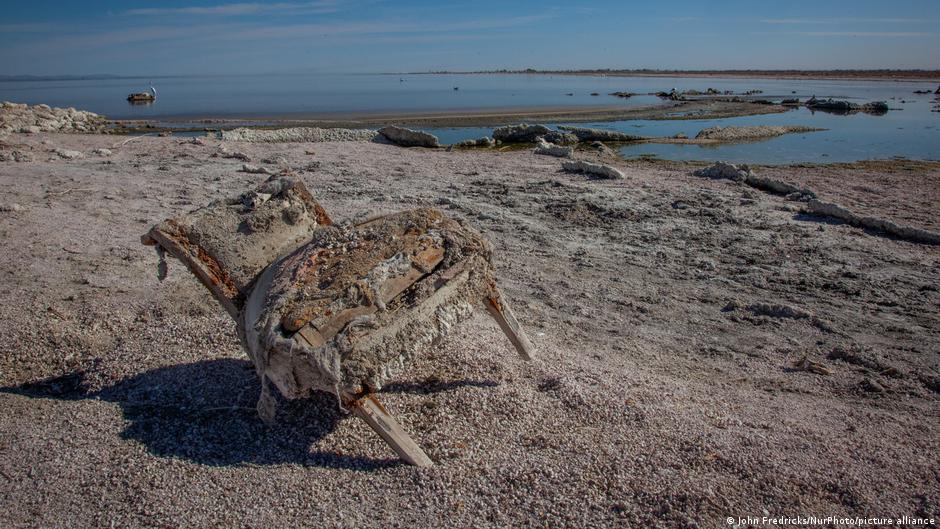
California's Salton Sea, once a vibrant recreational hub, is undergoing a profound transformation, shrinking at an alarming rate and exposing vast expanses of lakebed. This environmental shift is not merely an ecological concern; it has direct and severe consequences for human health, particularly for residents in the surrounding Coachella Valley. The exposed lakebed, laden with dust and toxic chemicals, contributes to poor air quality, exacerbating respiratory conditions and raising broader public health alarms.
For individuals like Michelle Dugan-Delgado, a 35-year-old resident of the Coachella Valley, the impact of the Salton Sea's decline is a daily reality. Diagnosed with asthma, she navigates life with an inhaler and face mask, constantly wary of the sudden dust storms that frequently sweep through the region. Her personal experience underscores the severity of the situation; she has faced multiple hospitalizations due to asthma attacks triggered by the dusty environment. The invisible threats carried by the dust—bacteria, fungal spores, and viruses—present a constant risk of life-threatening infections.
The tragic loss of her younger sister, Marie, to an asthma attack at the age of 16 in 2009, deeply affects Dugan-Delgado, fueling her conviction that the region's compromised air quality is responsible for the health struggles of her family and many others. This sentiment resonates within the community, where respiratory illnesses are disproportionately prevalent.
Dust Storms and Respiratory Health
The Coachella Valley, home to approximately 500,000 people, experiences frequent dust storms, largely attributed to the drying Salton Sea. As California's largest lake, covering an original area of 343 square miles (888 square kilometers), its rapid shrinkage exposes parched sediment. When strong winds traverse these exposed areas, they lift the dry earth, creating dust storms that carry particulate matter and other contaminants into the air. This phenomenon is directly linked to a significant increase in respiratory ailments among the local population.
Studies conducted on children residing near the lake reveal a troubling pattern. One particular study, tracking over 700 primary-school-aged children, found that 24% suffered from asthma. This figure dramatically surpasses the national averages, which stand at approximately 7% for boys and 5.5% for girls. Furthermore, over 70% of these children experienced allergies, more than triple the national average. Dugan-Delgado's own children are part of this statistic, with her 13-year-old daughter having asthma and her 11-year-old son battling allergies, illustrating the widespread nature of these health challenges within the community.
From Accidental Oasis to Environmental Crisis
The Salton Sea's origins trace back to an accidental inundation in 1905 when the Colorado River breached an irrigation canal. For decades, it thrived, sustained by agricultural runoff and local river inflows, transforming into a popular resort destination in the 1950s, attracting tourists and celebrities. However, this prosperity was short-lived. A combination of rising temperatures due to climate change and water diversion policies led to a steady decline in water levels. Over the past three decades, the lake has shrunk by about 20%, or 70 square miles, revealing more than just dust. Pesticides and other toxic agricultural chemicals, once submerged, are now left exposed on the lakebed, further contributing to the hazardous air quality when dispersed by wind.
Amato Evan, a professor of climate science at the Scripps Institution of Oceanography at the University of California, San Diego, emphasizes the role of climate change in intensifying these issues. The continued burning of fossil fuels fuels hotter temperatures and prolonged droughts, rendering desert regions globally more arid. This aridity hinders vegetation growth and strains water resources, contributing to an observed increase in the frequency of dust storms over time. Globally, human activities, including off-roading, deforestation, and unsustainable agricultural practices, account for at least a quarter of atmospheric dust emissions. Drying lakes, from California's Salton Sea to Iran's Lake Urmia, are significant contributors to this global dust problem, with the shrinking Aral Sea alone making Central Asia 7% dustier over the last 30 years.
Global Impact of Dust Storms and Health Risks
The issue of dust storms extends far beyond regional concerns. The World Meteorological Organization estimates that sand and dust storms affect approximately 330 million people annually. These events can engulf entire cities, disrupt air travel, devastate agricultural yields, and cause fatal traffic incidents. The most critical impact, however, is on human health. According to Evan, the inhalation of dust particulate matter is the primary adverse effect. These microscopic particles can penetrate deep into the lungs, leading to severe respiratory illnesses and heart disease. Globally, dust-related health issues are responsible for an estimated 721,000 deaths each year, with children, the elderly, and individuals with pre-existing lung conditions being particularly vulnerable.
Mitigation Efforts and Future Outlook
Despite the grim prognosis for the Salton Sea, which is predicted to continue shrinking, state and local authorities have initiated projects aimed at mitigating the environmental and health impacts. A plan to restore 30,000 acres of the lake's dusty shoreline by 2028 includes strategies such as laying out thousands of hay bales to suppress dust, planting native vegetation to stabilize the soil, and creating artificial wetlands by pumping in water for wildlife. While initiatives like planting native vegetation can be effective in combating desertification, Professor Evan highlights the substantial investment, water, and time required for such endeavors, resources that are not infinitely available.
Evan and his team are also developing an early warning system to alert communities about impending dust storms, akin to weather forecasts. Such a system would be invaluable for residents like Dugan-Delgado, who longs for greater awareness and education regarding the health risks associated with dust pollution. She believes that equipping families with knowledge about respiratory illnesses in the valley and preventive measures is crucial, emphasizing that “One death is too many and we just got to find a way to stop that.” The ongoing struggle at the Salton Sea serves as a stark reminder of the complex interplay between environmental degradation and public health, necessitating comprehensive and sustained efforts to protect vulnerable communities.