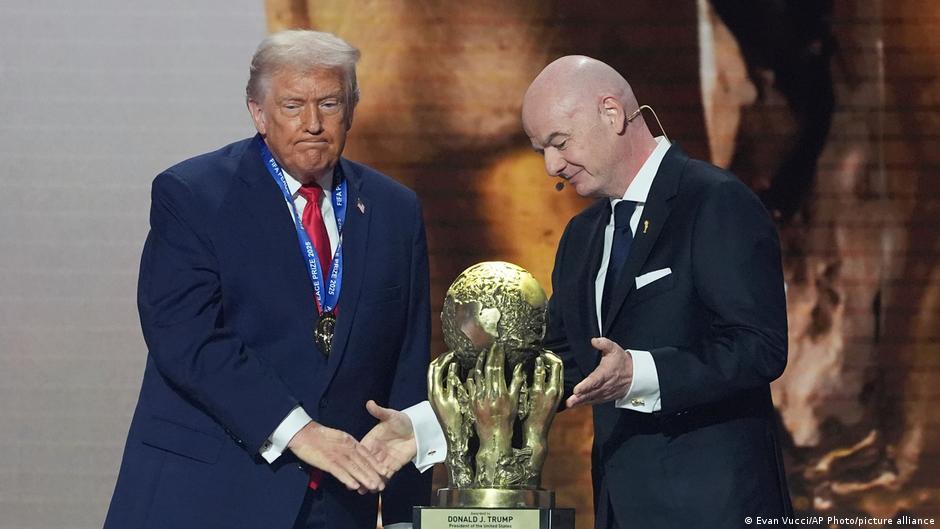
Presidential Intervention in Sports Governance
A recent development in international football has drawn widespread attention and sparked considerable debate, centering on a decision by FIFA to lift a red card suspension for a player ahead of a crucial match. Reports indicate that this reversal occurred after an alleged intervention by US President Donald Trump, who reportedly contacted FIFA President Gianni Infantino to advocate for the player, Folarin Balogun. The player was initially set to miss an upcoming game against Belgium due to a red card offense, but FIFA's subsequent decision has since allowed him to participate, much to the surprise and dismay of the Belgian Football Association.
The circumstances surrounding this decision have raised questions about the autonomy of sports governing bodies and the potential influence of external political figures on their rulings. While direct confirmation of the nature and impact of the alleged conversation between President Trump and Infantino remains under scrutiny, the timing and outcome have fueled speculation and criticism from various quarters within the football community and beyond.
The Incident and Initial Ban
Folarin Balogun, a forward for the United States national team, received a red card in a previous World Cup qualifying match. This disciplinary action would typically result in a one-match suspension, an automatic consequence under FIFA's disciplinary regulations. Such suspensions are standard practice to maintain fair play and uphold the integrity of the game. The expectation was that Balogun would be unavailable for the highly anticipated fixture against Belgium, a match deemed significant for both teams' World Cup aspirations.
The initial red card incident itself was not without its own discussion, as is often the case with contentious on-field decisions. However, the subsequent disciplinary process was largely considered routine until the unexpected announcement of the ban's suspension. This move by FIFA deviates from conventional protocol, where red card penalties are usually upheld unless there are exceptional circumstances, such as a clear and undeniable error in the referee's decision, often identified through a formal appeal process and review by a disciplinary committee.
Belgian FA's Strong Reaction
The decision to lift Balogun's ban was met with immediate and strong condemnation from the Belgian Football Association (FA). A spokesperson for the Belgian FA reportedly described the ruling as "astonishing," conveying a sense of disbelief and profound dissatisfaction. The association's reaction suggests that they perceive the decision as not only unfair but also potentially undermining the established rules and spirit of competition.
From Belgium's perspective, the sudden reinstatement of a key opposing player, especially one who was expected to be sidelined due to disciplinary action, could be viewed as a significant disadvantage. Such a ruling might be seen as disrupting their strategic preparations for the match, which would have factored in the absence of a prominent opponent. The Belgian FA's strong language highlights their concern that the integrity of the competition could be compromised if disciplinary decisions can be overturned under unusual circumstances or perceived external pressure.
Implications for Sports Governance and Fair Play
This incident opens a broader discussion about the independence and impartiality of international sports federations. FIFA, as the global governing body for football, is tasked with ensuring fair competition and enforcing its own rules consistently across all member nations. Any perception of political interference or preferential treatment for certain teams or players can erode public trust in the organization and the sport itself.
The principle of 'fair play' is a cornerstone of competitive sports. When decisions are made that appear to deviate from established norms without clear and transparent justification, it can lead to accusations of bias or undue influence. This particular case, with the alleged involvement of a head of state, amplifies these concerns significantly. It poses questions about the extent to which political leaders can or should attempt to sway the outcomes of sporting disciplinary processes.
Moreover, the incident could set a precedent, potentially encouraging other political figures to intervene in sports matters if they believe it could benefit their national teams or athletes. Such a scenario could lead to a less predictable and less equitable global sporting landscape, where outcomes are influenced by factors beyond on-field performance and adherence to regulations.
Looking Ahead: The Match and Beyond
As the match between the United States and Belgium approaches, all eyes will be on Folarin Balogun's performance and the broader implications of FIFA's decision. The controversy has undoubtedly added an extra layer of tension and scrutiny to the game. Regardless of the outcome on the field, the debate surrounding the lifting of the red card ban is likely to continue, prompting further examination of FIFA's governance practices and the delicate balance between sports, politics, and fair play.
The incident serves as a stark reminder of the complex interplay between various powerful entities in the world of international sports and the constant need for transparency and adherence to established protocols to maintain the sport's credibility and public confidence.
Source: Original Article