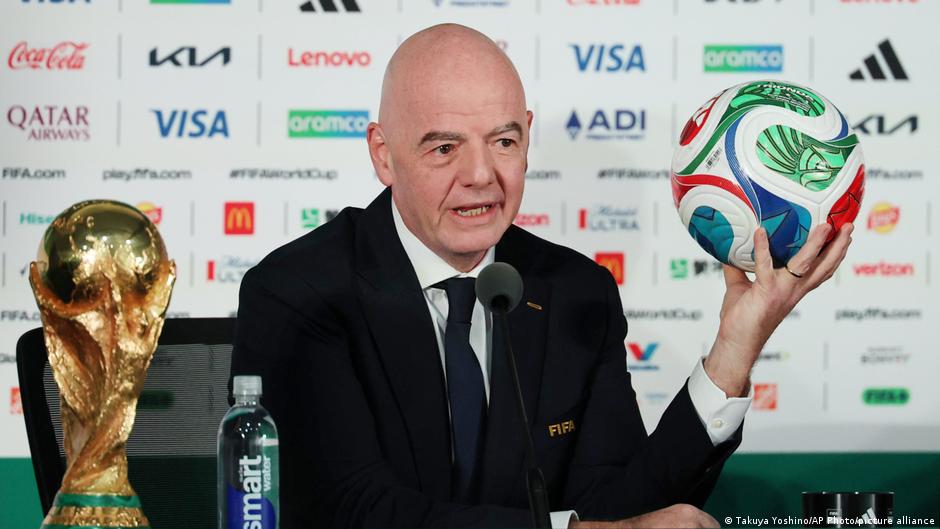
FIFA's Unwavering Grip on Global Football
The global spectacle of the World Cup continues to captivate audiences worldwide, yet the organization behind it, FIFA, faces increasing scrutiny. While the tournament itself thrives on the heroic performances of players and the passion of fans, FIFA's governance and decision-making processes have drawn significant criticism. This has led many to question the necessity of FIFA in its current form and whether any viable alternatives exist for the sport's future.
Recent World Cup events, while celebrated for their on-field drama, have also highlighted underlying issues. Reports surfaced regarding visa denials for Argentine fans hoping to witness Lionel Messi's historic achievements, and the mother of a Cape Verdean goalkeeper only secured a visa waiver after her son's standout performance. The exorbitant ticket prices further underscore a perception that the sport's biggest events are increasingly inaccessible to the average fan, diverting attention from the administrative controversies that often precede them.
Erosion of Trust: FIFA's Leadership Under Scrutiny
Several actions have contributed to a growing sense of disillusionment with FIFA. A notable instance was the reported unilateral decision by FIFA President Gianni Infantino to award former US President Donald Trump the inaugural FIFA Peace Prize in December, shortly before a military conflict involving a World Cup participant. This move reportedly deepened distrust both within and outside the organization.
Concerns have also been raised about the World Cup hosting rotation policy. While the system typically ensures different confederations host the tournament in turn, the arrangement for the 2030 World Cup across Europe, Africa, and South America seemingly paved the way for Saudi Arabia to secure the 2034 tournament without opposition, significantly earlier than Asia's turn would normally occur in 2042. With Infantino also expected to extend his presidency beyond the usual 12-year limit, likely unopposed, frustration with FIFA's internal mechanisms appears to be at an all-time high among observers.
The Pillars of FIFA's Power
FIFA's dual role as both the global developer and commercial operator of football is a system that many governance experts have questioned. The World Cup serves as the primary financial engine, supplemented by the recently expanded Club World Cup. However, the latter has sparked widespread complaints from players and unions regarding a congested calendar and excessive demands on athletes. England striker Harry Kane notably commented on the lack of player consultation regarding these decisions.
Structurally, FIFA's power is rooted in its electoral system, where each of the 211 member nations receives a single vote for the presidency every four years. These member associations are then supported financially through various programs. Miguel Maduro, a former chairman of FIFA's Governance, Audit and Compliance Committee, highlighted this dynamic, stating, "The commercial dimension is the bedrock of FIFA's system of power. The money is used by the presidents to accumulate and consolidate their power." He further explained that this system of patronage rewards loyalists and marginalizes critics, explaining why incumbent presidents often face no challenge.
External Pressure: The Call for Reform
Given the internal resistance to change, experts like Nick McGeehan of the human rights NGO FairSquare believe that any meaningful reform must be externally imposed. He advocates for intervention from entities such as the European Union, suggesting that they could regulate sport similarly to how they oversee other sectors like Big Tech. FairSquare has lodged a complaint with the FIFA Ethics Committee regarding Infantino's interactions with Trump, while fan groups have raised concerns with the European Commission about World Cup ticket pricing.
Despite the EU's confirmation that its laws do not dictate event ticket prices, it emphasizes that traders must provide transparent pricing and avoid misleading or high-pressure sales tactics. While definitive political action remains limited, McGeehan holds out hope for a politician who will recognize the value in holding FIFA accountable. "There is going to be a politician somewhere who recognizes the political value of taking people on and actually trying to hold them accountable. And I find that quite an exciting prospect, because I think it's inevitable right now."
Tensions with UEFA and the Prospect of a Breakaway
Under FIFA's overarching authority, simmering tensions exist with the influential European federation, UEFA. These were evident when UEFA hired a Somalian referee for the Super Cup final shortly after he was denied US entry for the World Cup, a move UEFA President Aleksander Ceferin framed as connecting people. Last year, UEFA delegates walked out of a FIFA Congress, accusing Infantino of prioritizing "private political interests" following a diplomatic tour. Geoff Walters, a professor in sports business, suggests that any significant breakaway movement would likely originate from UEFA or a coalition of European nations, given their historical influence.
However, Walters notes the inherent risks for federations challenging FIFA, as such actions could jeopardize hosting bids or lead to ostracization. Germany's post-2022 World Cup stance, where the team scaled back political gestures after their initial protest, is cited as an example, possibly influenced by future hosting aspirations. Even UEFA itself faced a challenge from a proposed elite-club-driven Super League, highlighting governance issues within its own structure, albeit less pronounced than FIFA's.
The global implications of a European-led breakaway are also complex. Ceferin's reported comments about the expanded World Cup making many matches "uninteresting" drew criticism from African and Asian football associations. FIFA's power base in Asia and Africa, cultivated by Infantino, suggests that a European-centric breakaway might struggle to gain broader international support, potentially leaving smaller nations marginalized. Walters emphasizes this challenge: "If it was spearheaded by leading nations, what would happen to the smaller nations across the world? What would happen to their ability to develop football in their countries?"
FIFA's Stated Mission and Future Outlook
Despite the criticisms, Infantino maintains that FIFA's commercial motivations serve a greater good. He stated on the eve of the tournament that "Every dollar we generate goes back into football," and highlighted FIFA's investment in football development in regions often overlooked by others, such as South Sudan and Bhutan. For now, FIFA remains deeply embedded in the sport, possessing both the mandate and the financial resources that no other entity currently matches.
While discontent with FIFA's governance is arguably at an all-time high, the prospects of a significant breakaway or fundamental reform remain slim. Unless a powerful federation, a strong alliance of nations, or a prominent individual steps forward to decisively challenge the status quo, FIFA's enduring influence over global football appears set to continue.
Source: Original Article