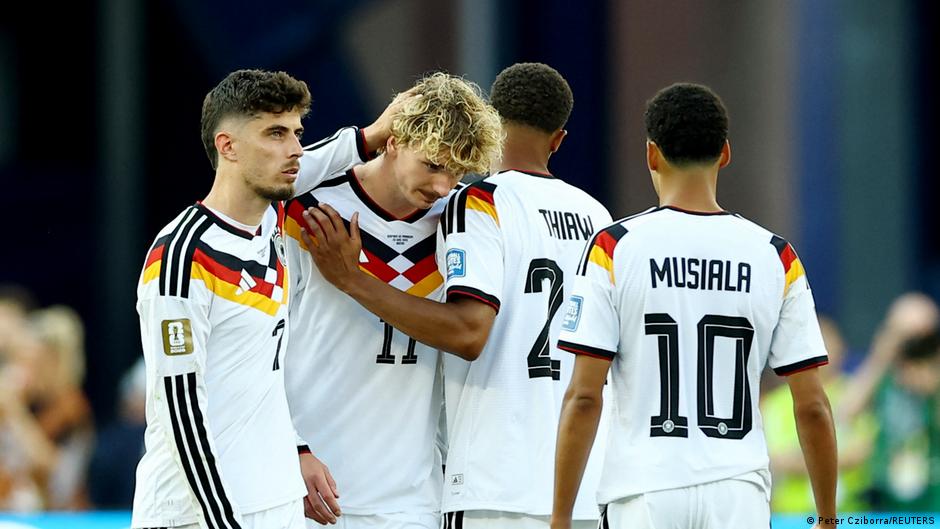
Germany's Recent World Cup Performance Under Scrutiny
The German national football team has faced significant challenges in recent World Cups, leading to a period of introspection within the sport. Following three consecutive tournaments with disappointing outcomes, prominent figures in German football have offered various perspectives on the root causes. Philipp Lahm, a former captain, has pointed to a perceived lack of identity within German football. Toni Kroos, a decorated midfielder, suggests a deficit of world-class talent, while Mats Hummels, a defender, highlights systemic issues. These discussions underscore a complex situation with multiple contributing factors.
Frank Wormuth, a seasoned football professional with experience as a player, coach-educator for the German Football Association (DFB), and a mental coach, emphasizes the importance of context. He argues that the playing philosophy itself might not be the primary issue, but rather the quality of players executing that philosophy.
Individual Player Form and Tactical Impact
Wormuth elaborates on the individual form of key players, noting that some of Germany's top talents have not consistently performed at their peak. He cites examples such as Florian Wirtz, who had a less-than-ideal season, Jamal Musiala, who faced a prolonged injury, and Leroy Sané, described as an 'eternal prospect.' According to Wormuth, when critical creative players are not in optimal form, it directly impacts the team's offensive capabilities, irrespective of the coach's strategies. He also references Kai Havertz, describing him as a player who thrives on passes and whose occasional goal-scoring is not always consistent. Wormuth suggests that in high-stakes tournaments, small details, such as a missed penalty by a reliable taker, can significantly alter outcomes.
The defensive aspect of the German team has also come under scrutiny. Wormuth highlights the impact of Nico Schlotterbeck's early injury in a tournament, which was seen as a major blow due to the absence of a left-footed player capable of initiating build-up play. He questions the overall defensive prowess of the team, particularly in one-on-one situations, suggesting a disparity when compared to the physical approach of other leading international teams.
Youth Development, Culture, and Societal Shifts
Discussions around Germany's football struggles often extend to the structure of its youth development programs. While recent changes to the youth system are still too new to fully assess their long-term impact, the perceived character of young players has become a point of concern. Mark O'Sullivan, an associate professor of football at the Norwegian School of Sport Sciences, offers an international case study with Bodo/Glimt, a Norwegian club that emphasizes shared values, culture, and player development. This approach, which fosters trust, humility, collective responsibility, and continuous improvement, has led to significant on-field success, including reaching the Champions League round of 16.
“Ultimately, the reason Germany isn't successful comes down to culture, training, and youth development,” Wormuth stated. “The most important thing of all is mindset, and that has changed. Now you might ask, 'How?' Well, I'll tell you: Society. School. Upbringing. Parents. Culture. Things have changed.”
Wormuth suggests that a broader societal shift has influenced the mindset within German football. He argues that a perceived 'softening' in society, school, upbringing, and parental approaches has translated into a less resilient footballing culture. He contrasts this with teams that exhibit a 'culture of survival,' suggesting Germany now lacks this competitive edge. He believes that while Germany develops technically skilled players, they may lack the mental fortitude often seen in other footballing nations. This perspective posits that the issues are not solely about coaching or academy training but are deeply intertwined with societal evolution.
Investing in Infrastructure and Future Directions
The discussion also touches upon the role of infrastructure. While the German government has pledged significant investment (€333 million or $380 million) to renovate and modernize 314 sports facilities, O'Sullivan warns against the 'spatial fallacy.' He emphasizes that the mere existence of facilities does not guarantee participation or meaningful engagement in sport. The upgrading of facilities must be part of a larger strategy to foster a genuine connection to sport among German youth.
The anticipated appointment of Jürgen Klopp as Germany's new men's head coach is seen as a potential turning point. German football appears to be at a critical juncture, and the decisions made in the coming years are expected to have a lasting impact on its trajectory.
Source: Original Article