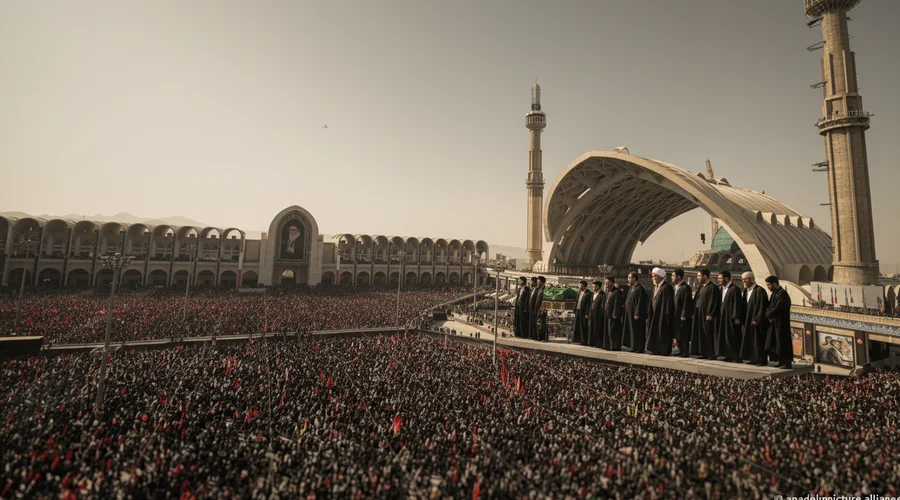
Funeral Proceedings for Iran's Late Supreme Leader Continue
The second day of funeral ceremonies for Iran's Supreme Leader, Ali Khamenei, saw the attendance of numerous high-ranking officials and members of his family. The solemn event, held in Tehran, drew significant public attention, particularly due to the absence of his designated successor, Motjaba Khamenei, sparking further conjecture regarding his whereabouts and condition.
Reports indicate that Motjaba Khamenei has not been seen publicly for several months. His disappearance from the public eye follows an airstrike on February 28, which reportedly resulted in the death of his father and several others. Unconfirmed accounts suggest that Motjaba sustained severe injuries in the attack, including facial disfigurement and significant damage to his legs, contributing to the widespread speculation.
Family and Military Figures Present at Mourning Event
Among those present on Sunday were Khamenei's sons, Meysam, Mostafa, and Masoud. Masoud Khamenei was observed visibly emotional, using a keffiyeh – a symbolic gesture of solidarity with Palestinians – to wipe away tears. This appearance marked their first public presence since the commencement of the conflict. The gathering also included prominent military figures, such as General Ahmad Vahidi, leader of the Islamic Revolutionary Guard Corps (IRGC), who was photographed for only the second time since the conflict began, surrounded by plainclothes security personnel. Esmail Qaani, who commands the Revolutionary Guard's expeditionary Quds Force, was also in attendance.
President Masoud Pezeshkian and Parliament Speaker Mohammad Bagher Qalibaf were seen participating in prayers behind Khamenei's coffin. The Supreme Leader's coffin was positioned alongside those of his daughter, son-in-law, daughter-in-law, and his 14-month-old granddaughter, all of whom were also reported to have perished in the same airstrike. A smaller coffin, believed to contain the remains of the infant granddaughter, was notably placed beside the larger caskets.
The ceremony was facilitated by poet Mohammad Rasouli, who led the attendees in chants, including traditional calls of "Death to America!" and "Death to Israel!" In his address, Rasouli voiced criticism of US President Donald Trump, asserting that "the world is no longer a good place for" the American leader.
Thousands Gather Amidst High Temperatures
Thousands of mourners, many carrying flags, filled the Imam Khomeini Grand Mosalla in Tehran. The city experienced high temperatures, nearing 35 degrees Celsius (95 degrees Fahrenheit), necessitating the deployment of mist machines and the distribution of refreshments to help attendees cope with the heat.
Funeral Procession and Diplomatic Implications
Authorities have indicated preparations for a substantial procession in central Tehran scheduled for Monday. Following this, Khamenei's remains are slated for transport to the seminary city of Qom. Subsequently, the body will be flown to Iraq, where additional ceremonies are planned for Wednesday in the Shi'ite holy shrine cities of Najaf and Kerbala. The final leg of the journey will see Khamenei's return to Iran for burial near the Shi'ite Imam tombs in Mashhad.
The week-long funeral proceedings have temporarily interrupted ongoing discussions with the United States aimed at establishing a lasting resolution to the conflict. Former US President Donald Trump reportedly informed the US news website Axios that he would refrain from any military actions against Iran during the funeral period to preserve the integrity of these negotiations. A significant public turnout during the funeral is perceived by some as a potential strategic advantage for Iran in future diplomatic engagements.
A mourner in Tehran, speaking to the Associated Press, articulated a sentiment shared by many: "Our foreign policy should not be shaped in a way that allows our martyred leader's blood to be dishonored and other countries can afford to do such things, without any serious response from our government and diplomatic system." This statement underscores the public's expectation for a strong governmental response and a robust diplomatic stance following the events leading to the Supreme Leader's demise.
Source: Original Article