The Unfolding Controversy of Mid-Match Pauses
The 2026 World Cup has introduced a new element that has quickly become a focal point of discussion: mandatory hydration breaks. These scheduled pauses, implemented approximately 22 and 67 minutes into each match, have elicited strong reactions from spectators, participants, and football analysts worldwide. While initially conceived with player welfare in mind, their practical application has led to considerable debate regarding their influence on game dynamics, tactical opportunities, and even commercial interests.
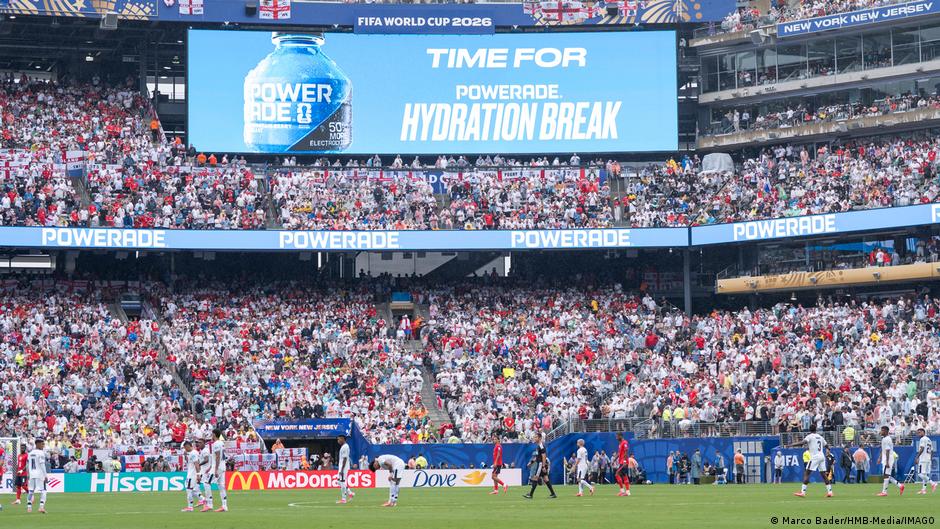
During a group stage encounter between England and Ghana, a scheduled hydration break at the 22-minute mark was met with audible displeasure from the crowd at Boston Stadium. Players utilized this interlude to approach the sidelines, where coaches seized the opportunity to provide immediate tactical guidance. This scenario has become a common sight, highlighting how these mandatory interruptions are polarizing the football community.
Coaches' Perspectives and Criticisms
Jürgen Klopp, a prominent figure in football management, expressed a nuanced view. He acknowledged the strategic advantage these breaks offer, stating, "As a coach, I would have loved it," referring to the additional time for tactical adjustments. However, the former Liverpool and Dortmund manager also voiced concerns regarding the duration of these breaks and the activities undertaken by broadcasters and FIFA during these periods. This suggests that while coaches appreciate the tactical window, they are also cognizant of broader implications that extend beyond the pitch.
From Player Welfare to Tactical Timeouts
The official rationale behind the hydration breaks is player protection from heat. Unlike previous tournaments or league matches where such decisions were often contingent on prevailing temperatures, these breaks are now a fixed component of every World Cup game. This universal application, irrespective of environmental conditions, has transformed what was intended as a health measure into a significant point of contention. An Iraqi fan in Philadelphia articulated a common sentiment, remarking, "I don't like this water break. If the players really need a drink, they should just do it before taking a corner kick." This sentiment was echoed by another fan observing a match in a climate-controlled stadium in Dallas, questioning the necessity of hydration breaks when air conditioning was actively in use.
The most substantial aspect of the debate revolves around the impact on game flow. What was designed as a brief moment for hydration has frequently evolved into a de facto tactical timeout. Coaches are observed re-evaluating formations, issuing instructions, and potentially disrupting the opposing team's rhythm. An Argentine supporter noted, "On one hand, the breaks have changed the game by giving coaches more influence; on the other, they break the flow of play for the fans."
Empirical evidence supports this observation. Research conducted by 'The Times,' utilizing Opta data from group-stage matches, indicated a significant shift in momentum in 32% of games following the first hydration break and in 26% after the second. On average, match momentum experienced a 17% decline post-interruption. Notably, teams that held a momentum advantage prior to a break often experienced a more pronounced decrease afterward, suggesting a tangible disruption to established patterns of play.
Player and Manager Concerns
Players and managers have also expressed reservations. Virgil van Dijk, captain of the Netherlands, commented that the interruptions are "far from ideal" for television viewers. While acknowledging the value of water breaks in extreme heat, he advocated for a match-by-match assessment rather than a blanket rule. England manager Thomas Tuchel criticized the breaks for unnecessarily extending match durations. Paraguay coach Gustavo Alfaro went further, suggesting that football is increasingly resembling a game played in four quarters, drawing a parallel with American sports like basketball and American football, which are structured in this manner.
Financial Implications and FIFA's Stance
A significant dimension of the controversy involves potential financial motivations. In numerous countries, broadcasters are leveraging these guaranteed stoppages for commercial breaks, a practice previously uncommon in football. An American fan observed, "They have to fit in their advertising; from a corporate perspective, that probably makes sense." Furthermore, the hydration breaks themselves have attracted sponsorship, with the sponsor's name displayed on stadium screens at the commencement of each pause.
FIFA President Gianni Infantino has refuted claims that the global governing body is financially benefiting from these breaks. He stated, "We don't earn a single extra dollar from the hydration breaks because all the contracts were already signed before they were introduced." Infantino also announced that FIFA would thoroughly evaluate the experiences from this World Cup before making a definitive decision on the future of hydration breaks.
Medical Perspectives and Future Considerations
From a medical standpoint, sports doctors generally agree on the benefits of additional hydration opportunities in extreme heat. Sports physician Tim Meyer noted in '11 Freunde' that "cooling breaks" can positively impact body temperature. He added, "In extreme conditions, players run less – and, above all, less intensely – and play more safe passes. From a health perspective, that is probably sensible, but it certainly isn't in the spirit of the sport."
The debate has evolved beyond simply whether players require heat protection to encompass the optimal form of this protection and whether these breaks should be uniformly applied across all matches, irrespective of temperature. The World Cup has, therefore, become a testing ground for a new rule with far-reaching implications for the sport.
Source: Original Article