Reform UK Leader's Strategic Move
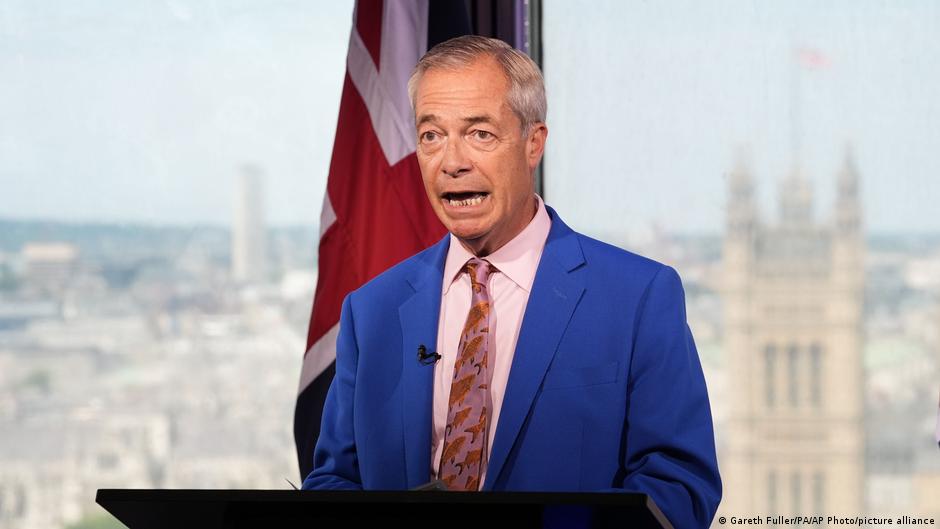
Nigel Farage, the prominent figurehead of Reform UK, has announced his resignation from his position as a Member of Parliament, a move that will trigger a by-election in his constituency. This development unfolds amidst heightened scrutiny concerning financial support he reportedly received but did not declare. Farage's decision to step down and subsequently seek re-election is being interpreted by observers as a strategic maneuver to address the ongoing questions surrounding his financial affairs while simultaneously reasserting his political mandate.
The circumstances leading to this resignation involve allegations of undeclared financial contributions, which have drawn the attention of regulatory bodies and the media. While specific details of these contributions remain a subject of public discussion, the general implication is that they were not disclosed in accordance with parliamentary rules and transparency standards. Farage's response has been to challenge the premise of these inquiries by opting for a direct appeal to the electorate through a by-election.
The Mechanics of a By-Election
A by-election is a special election held to fill a vacancy in a political office, in this case, a seat in the House of Commons. Such vacancies can arise due to various reasons, including the death or resignation of the incumbent, or their disqualification from office. Once a Member of Parliament resigns, the Speaker of the House of Commons is formally notified, and a writ is issued to initiate the electoral process in the affected constituency. This process typically involves a period for nominations, campaigning by prospective candidates, and ultimately, a polling day where constituents cast their votes to elect a new representative.
For Farage, triggering a by-election offers a distinct political advantage. It allows him to frame the narrative around his resignation as a matter of principle and a desire to seek a fresh mandate from his constituents, rather than being perceived as yielding to pressure from investigations. By standing again, he effectively puts his political future directly in the hands of the voters in his constituency, transforming a potentially damaging controversy into an opportunity for renewed legitimacy.
Implications for Reform UK and the Political Landscape
Nigel Farage's decision holds significant implications not only for his personal political career but also for the trajectory of Reform UK. As a relatively new political entity, Reform UK aims to challenge the established political order, particularly on issues such as immigration, national sovereignty, and economic policy. Farage's leadership is central to the party's identity and its ability to garner public attention.
A successful re-election campaign would undoubtedly bolster Farage's standing and provide a platform for Reform UK to amplify its message. It could be presented as a public endorsement of his leadership and the party's agenda, potentially attracting more support ahead of a general election. Conversely, a defeat in the by-election would represent a significant setback, raising questions about his political viability and the broader appeal of Reform UK's platform.
The timing of this by-election also places it within a broader context of political uncertainty in the UK. With ongoing debates on various domestic and international issues, and the prospect of a general election on the horizon, any electoral contest, particularly one involving a high-profile figure like Farage, is likely to attract considerable media attention and public interest. The outcome could be interpreted as a barometer of public sentiment towards alternative political movements and the performance of the incumbent government.
Historical Precedents and Public Perception
Resigning from a parliamentary seat to seek re-election is not an unprecedented tactic in British politics. Historically, politicians have sometimes employed this strategy to resolve controversies, demonstrate public support, or even to transition between different political roles. Such moves are often calculated to reframe a difficult situation into an opportunity for renewal and a renewed mandate.
However, the public's perception of such a move can vary. While some might view it as a bold and democratic assertion of accountability, others might interpret it as an attempt to evade direct scrutiny or to manipulate the electoral system for personal political gain. The success of Farage's strategy will largely depend on his ability to convince the electorate of the legitimacy of his actions and to articulate a compelling vision for his continued representation.
The coming by-election will therefore be more than just a contest for a parliamentary seat; it will be a test of Nigel Farage's political resilience, an indicator of Reform UK's growing influence, and a snapshot of the evolving political landscape in the United Kingdom. The outcome will undoubtedly be closely watched by political commentators, rival parties, and the public alike.
Source: Original Article