Context of the Bonfire Tradition
In Northern Ireland, bonfires are a deeply ingrained part of certain cultural celebrations, particularly within loyalist communities. These pyres are traditionally ignited around July 11th, a day before the annual 'Twelfth of July' commemorations. The 'Twelfth' marks the 1690 Battle of the Boyne, a pivotal event in Protestant history, where King William of Orange defeated Catholic King James II. While often presented as a celebration of heritage and identity, these bonfires have, on numerous occasions, become flashpoints for controversy due to the inclusion of flags, symbols, and effigies deemed offensive or sectarian.
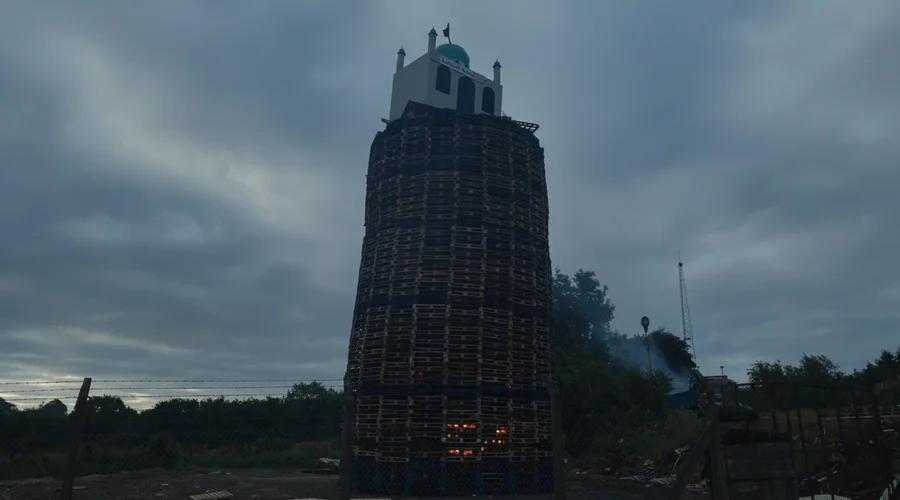
The scale of these bonfires can be considerable, with some reaching several stories high, constructed from pallets and other combustible materials. The events surrounding their lighting often draw large crowds, embodying a complex blend of cultural expression, community gathering, and, at times, political messaging that can be divisive.
The Incident in Antrim
In a recent development that garnered significant attention, a loyalist bonfire constructed in Antrim, Northern Ireland, was set alight ahead of schedule. This preemptive ignition occurred on Tuesday evening, July 9th, approximately 24 hours before its planned lighting. The early ignition effectively thwarted an intervention by law enforcement to remove a contentious item placed atop the pyre: a replica of a mosque.
The presence of the mosque effigy had provoked a strong negative reaction from various segments of society, leading to calls for its removal. Local authorities and police had been actively considering options to address the situation, but the early lighting rendered their efforts moot. The incident highlights the challenges faced by authorities in managing events that are both culturally significant to some communities and deeply offensive to others.
Condemnation from Leadership
The display, particularly the replica mosque, drew widespread condemnation from a diverse range of political and religious leaders. Michelle O'Neill, the First Minister of Northern Ireland, publicly denounced the act, describing it as "disgraceful and an absolute insult to the Muslim community." Her remarks underscored the severity with which the display was viewed by the highest levels of government, emphasizing the harm caused to inter-community relations.
The Grand Mufti of Ireland, Shaykh Dr. Umar Al-Qadri, also voiced strong disapproval, characterizing the incident as "Islamophobic" and a "hate crime." His statement highlighted the religious dimension of the offense, pointing to the potential for such displays to incite hatred and discrimination against Muslim individuals and communities. This sentiment was echoed by numerous other faith leaders and community representatives, who collectively called for respect and understanding across different religious groups.
Organizers' Justification and Public Reaction
In response to the widespread criticism, the organizers of the Antrim bonfire offered a justification for the controversial display. They asserted that the inclusion of the replica mosque was intended as a "political protest" against what they perceived as the "Islamification of Europe" and the construction of new mosques in Northern Ireland. This explanation, however, failed to mollify critics, who largely viewed it as an attempt to legitimize an act of sectarianism and religious intolerance.
The public reaction to the incident was varied but largely characterized by expressions of shock and disappointment. Many commentators and citizens took to social media and other platforms to voice their dismay at the offensive nature of the display, reiterating the importance of fostering an inclusive and respectful society. The event reignited discussions about the boundaries of free expression and the responsibility of organizers to prevent the use of cultural events for the promotion of hatred.
Ongoing Efforts for Reconciliation
The incident in Antrim serves as a stark reminder of the persistent challenges in Northern Ireland's journey towards complete reconciliation and social cohesion. Despite significant progress since the signing of the Good Friday Agreement, sectarian divisions and tensions occasionally resurface, often manifesting in culturally significant events like bonfires.
In the aftermath of such incidents, there is typically a renewed call from civic society and political figures for dialogue, education, and mutual respect. Organizations dedicated to peacebuilding and inter-community relations often intensify their efforts to bridge divides and promote understanding. The long-term goal remains to transform these cultural expressions into celebrations that are inclusive and respectful of all communities within Northern Ireland, rather than perpetuating symbols of division or offense.
Source: Original Article