Rebuilding and Reimagining the Ahr Valley After Catastrophic Flooding
In the aftermath of the devastating floods that swept through Germany's Ahr Valley on July 14, 2021, communities are engaged in an ambitious reconstruction effort, aiming not just to rebuild, but to 'build back better.' This initiative focuses on implementing advanced flood protection strategies and restoring natural river dynamics to safeguard against future extreme weather events. The calamity, which claimed 135 lives and caused billions in damages, particularly in towns like Bad Neuenahr-Ahrweiler, has prompted an unprecedented investment of state and federal funds into creating a more resilient landscape.
Alexandra Wiemer, a resident of Bad Neuenahr-Ahrweiler, vividly recalls the night the Ahr River, typically a gentle waterway, transformed into a raging torrent. The region experienced a month's worth of rainfall in just two days, leading to unprecedented water levels that engulfed homes, infrastructure, and lives. Wiemer and her son narrowly escaped, a stark contrast to the many who perished, primarily in her hometown where 80% of the area was submerged. The sheer force of the water decimated infrastructure along the riverbanks, highlighting the urgent need for a new approach to urban planning and flood defense.
Innovative Flood Protection Measures Taking Shape
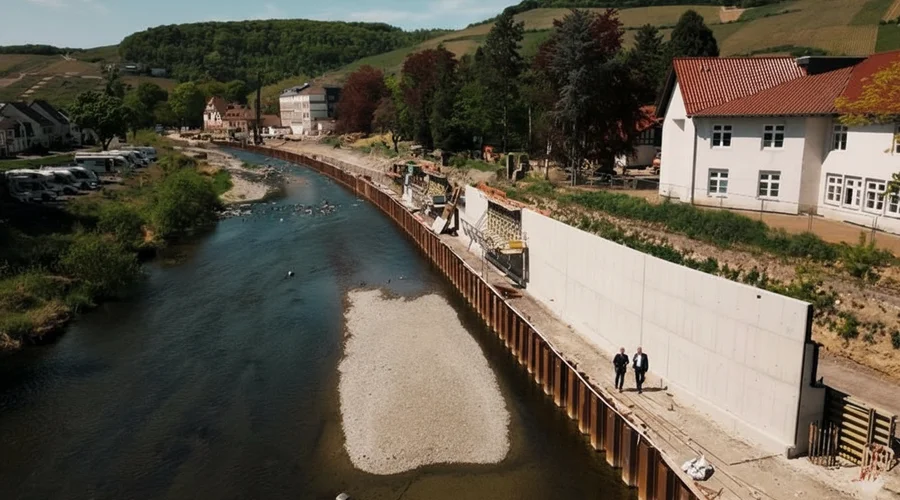
A cornerstone of the reconstruction strategy is the implementation of robust flood protection infrastructure. In Bad Neuenahr-Ahrweiler, a significant project involves the construction of a new 480-meter-long retaining wall. Hermann-Josef Pelgrim, managing director of the local reconstruction and development corporation, explains that this wall is designed for extreme durability, anchored by bored piles measuring 1.20 meters in diameter and driven 15 meters deep. This formidable barrier is intended to prevent a recurrence of the 2021 event, where the river breached the town's medieval wall and inundated the historic center.
Beyond large-scale barriers, numerous subtle yet effective safety measures are being integrated. These include building a new fire station on underground stilts to prevent collapse during floods and connecting urban green spaces to subterranean drainage trenches designed to absorb and redirect heavy rainfall. A critical aspect of the rebuilding effort involves redesigning the 16 bridges destroyed in 2021. For instance, a medieval five-arch bridge, though destroyed, will have its remnants preserved as a memorial, while its replacement will feature a single, wide arch. This design allows water and debris to pass underneath unimpeded, a significant improvement over previous structures that often acted as dams, exacerbating flood damage. Pelgrim asserts that these new bridges are engineered to withstand even the most extreme flooding scenarios, emphasizing a community-wide responsibility to prepare for future events.
Reclaiming Space for the River: A Natural Solution
Historical maps reveal that the Ahr River once meandered freely across its valley, often splitting into multiple branches. Over centuries, human development channeled the river and encroached upon its banks, drastically reducing its natural floodplain. This constriction meant that during heavy rainfall, floodwaters had nowhere to go but into populated and agricultural areas. The town of Altenburg, situated upstream from Bad Neuenahr-Ahrweiler, exemplifies this issue; during the 2021 flood, water levels surged to over 7 meters, compared to the usual 70 centimeters, submerging houses almost entirely.
Engineer Bruno Büchele, coordinating the waterway restoration, highlights the primary challenge: to restore the Ahr's natural space. This involves the county administration acquiring riverside plots from local farmers and private owners to convert them back into floodplains. These areas will be reforested with shrubs, trees, and bushes, allowing the river to expand naturally during high water events. Büchele notes, however, that these efforts will only be fully effective when complemented by upstream retention measures that reduce the overall volume of runoff. Both Büchele and Pelgrim advocate for the construction of dams along the Ahr and its tributaries to control water flow more effectively.
Learning from the Past, Planning for the Future
The concept of building retention basins is not new to the Ahr Valley. Following another devastating flood in 1910, similar plans were drafted but never implemented, with funds eventually diverted to other projects, such as the Nürburgring racing circuit. Today, one existing dam near Adenau, spanning a stream in a side valley, demonstrated its effectiveness in 2021 by holding 40 million liters of water, preventing disaster in the village. Inspired by this success, 17 more such dams, some as high as 25 meters, are now in the planning stages along the Ahr and its tributaries. This ambitious project, projected to cost over €1.5 billion ($1.7 billion), is expected to take decades to complete.
Despite these extensive communal efforts, individuals like Alexandra Wiemer are also taking personal precautions. Having relocated to a new house after the flood, she has installed flood barriers on her basement windows and keeps sandbags readily accessible. Yet, she remains close to the river, a testament to her enduring connection to the area. Her sentiment, shared by many flood survivors who have chosen to stay, is simple: 'Because it's nice to live by the water. And because I'm not afraid. Period.'
Source: Original Article