Contemporary Art Takes Center Stage at Bellevue Palace
Bellevue Palace, the official residence of the German President, has become the unexpected venue for a thought-provoking exhibition of contemporary art. Titled "Freiraum Kunst" (Art as Free Space), the two-week pop-up show, running from June 13-28, has garnered significant attention, particularly due to one of its more striking pieces: a green bronze cast of a Japanese sex doll torso, named "Eva," by artist Alexandra Bircken.
This exhibition, occurring just before the historic building closes for an extensive eight-year renovation, offers a rare public glimpse inside the presidential seat. The inclusion of such a diverse range of artistic expressions, from traditional oil paintings to video installations and provocative sculptures, aims to stimulate reflection on themes of democracy, power, representation, and public life within a highly symbolic political space.
President Steinmeier's Endorsement of Artistic Freedom
German President Frank-Walter Steinmeier, under whose patronage the exhibition was organized by the city's Academy of Arts, emphasized the crucial role of art in a democratic society. "We need art," he stated at a preview event. "A democracy without free art loses its capacity for self-criticism, and art without freedom loses its social relevance." This exhibition can be viewed as a valedictory gesture from Steinmeier, as his second and final term concludes next year, making his return to Bellevue Palace after renovations unlikely.
The palace has been largely cleared in preparation for its impending closure, providing an expansive, albeit temporary, canvas for the artworks. President Steinmeier is slated to relocate to an interim residence near Berlin's central train station during the renovation period.
Exploring Themes of Society and Politics Through Art
The exhibition's overarching theme of artistic freedom is immediately apparent even before entering the palace, with Christian Awe's monumental installation of the word "Freiraum" ("free space") adorning the palace roof. Inside, visitors are met with a diverse array of works that challenge conventional perspectives and encourage introspection.
Upon entering the foyer, an auditory installation by Jochen Gerz, titled "Rufen bis zur Erschöpfung" (To Call Until Exhaustion), plays a constantly repeated "Hallo." This 1972 performance, where the artist repeatedly called out until his voice failed, can be interpreted as a commentary on the limitations of expression, especially in an era dominated by social media's pursuit of attention. In a democratic context, it can highlight the frustration that arises when citizens' voices go unheard, potentially leading to a societal sense of exhaustion.
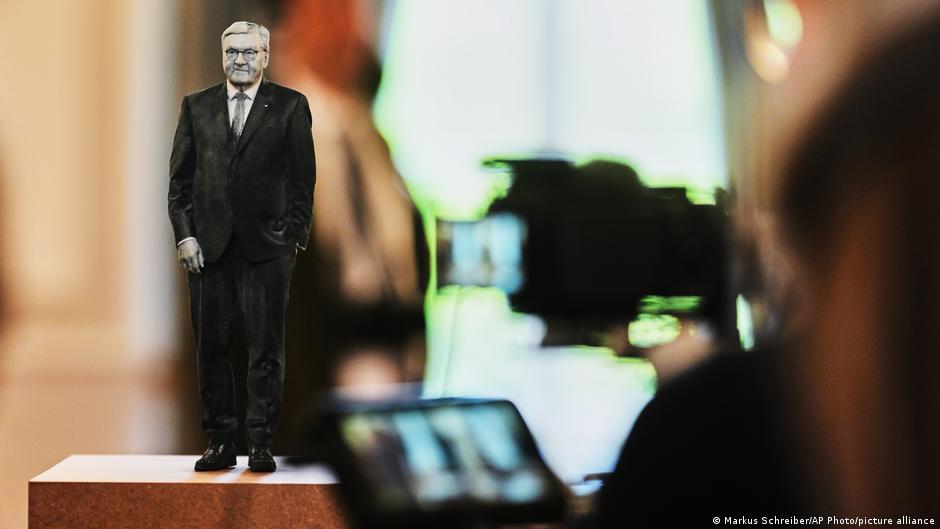
Other notable works include street artist El Bocho's painting, "Die Bundespräsidentin" (The Female President), which envisions a woman holding Germany's highest ceremonial office. Artist Karin Sander presents a miniature, 36-centimeter tall sculpture of President Steinmeier, positioned on a pedestal within the room typically used for political speeches.
"Eva" and the Dialogue on Intimacy and Objectification
The bronze sculpture "Eva" by Alexandra Bircken, depicting a sex doll torso, has undoubtedly generated the most headlines and social media discussion. Placed in a suggestive pose, its presence within the formal setting of a state palace forces a confrontation with questions surrounding the body, gender, sexuality, and the objectification of women. The juxtaposition of such an intimate subject matter within a highly formal environment creates a compelling tension, prompting visitors to consider how bodies are represented and controlled within society.
The exhibition also features works by other renowned artists, including Katharina Grosse, Wolfgang Tillmans, and Monica Bonvicini, whose collage "Hard String" incorporates body fragments from German-language lifestyle magazines. The diverse collection underscores the constitutional guarantee of freedom of art in Germany, one of the strongest fundamental rights within the nation's legal framework.
A Rare Opportunity for Public Engagement
Bellevue Palace, an 18th-century Prussian royal residence, became the official presidential seat in 1994. Typically, the building is not freely accessible to the public, making this exhibition a unique opportunity for engagement. The high demand for access was evident when the website for booking free tickets, totaling 35,000, crashed just hours after its launch. All tickets for the exhibition are currently sold out, though last-minute cancellations may offer limited additional entry slots.
Source: Original Article