Novelty Handbag Falls Short of High Hopes at Auction
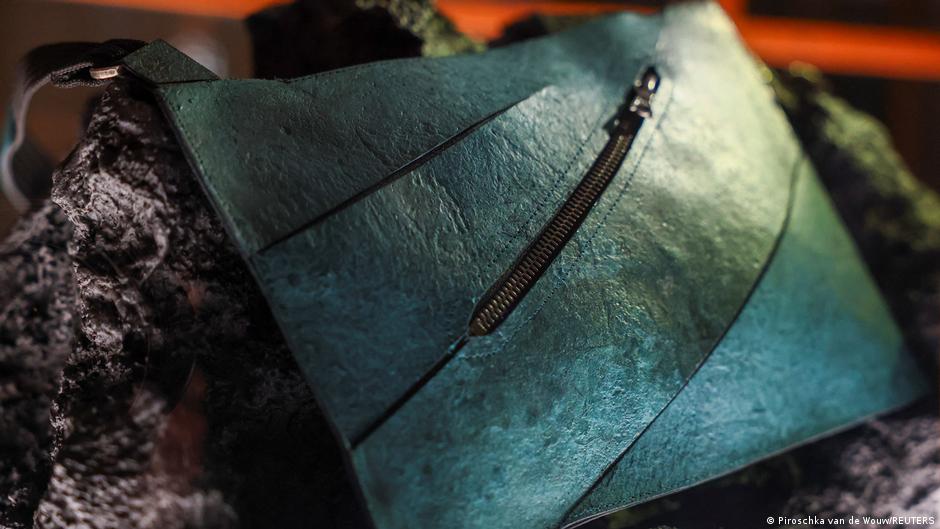
A highly anticipated auction of a handbag, touted as the “world’s first T. rex leather product,” concluded without a sale, as bids for the unique item failed to reach the expected price. The Paris auction house Drouot, which hosted the event, noted that offers were considerably lower than projected.
Earlier this year, the Artis Zoo Museum in Amsterdam showcased the handbag alongside a large dinosaur skeleton, generating significant public interest. Auctioneers Giquello had initially estimated the “one-of-a-kind” piece could fetch over $500,000. However, reports from the auction house indicate that bids barely surpassed the $150,000 threshold, leading to the item remaining unsold. Alexandre Giquello, whose firm organized the sale, conveyed to AFP that establishing a price for such an unprecedented item involved considering both the substantial investment in its creation and its inherent rarity.
The Genesis of an Experimental Product
The Polish fashion brand Enfin Leve was responsible for the handbag’s design, incorporating it into their line of experimental clothing. Nevertheless, it was the innovative material, rather than the aesthetic design, that garnered the most attention. The brand described the material on social media as having “a character unlike anything we’ve handled. Dense, primal, operating on its own logic.”
The central question surrounding the product revolved around the precise definition of “T. rex leather.” Dinosaurs vanished approximately 66 million years ago. While the 1990s film “Jurassic Park” ignited widespread fascination with dinosaurs and speculation about their potential cloning, scientists have consistently affirmed that dinosaur DNA degrades over time, making such cloning impossible.
The Debate Over Dinosaur Proteins
Approximately two decades ago, a significant discovery was made in Montana: fragments of a Tyrannosaurus rex skeleton. This find gained further prominence when paleontologist Mary Higby Schweitzer announced that her team had identified soft tissue remnants, including protein fragments, within the bones. This revelation challenged the long-held scientific belief that such organic material could not endure for millions of years.
Despite Schweitzer’s findings, a degree of skepticism persisted within the scientific community. Some researchers proposed that bacteria colonizing the bones might have created the structures Schweitzer identified. The scientific debate regarding the exact nature of her team’s discovery continues to this day.
The Amsterdam handbag project draws upon data from this Montana discovery, according to a preprint by Thomas Mitchell and Ernst Wolvetang, co-founders of The Organoid Company, which played a role in developing the lab-grown leather. Mitchell described the intricate process in an Instagram video, likening it to assembling a puzzle with only a few pieces, requiring the rest to be filled in.
A critical unresolved question is whether the original fragments genuinely originated from a T. rex. Postdoctoral researcher Jan Dekker from the University of Turin, an expert in paleoproteomics—the scientific study of proteins from ancient remains—expresses reservations. “Dinosaur proteins are very controversial,” Dekker stated to DW. He elaborated that the established limit for protein survival was only recently extended to around 20 million years under highly exceptional circumstances. Given that T. rex existed more than three times that long ago, Dekker doubts the handbag contains any actual dinosaur material.
More Avian Than Prehistoric?
Lab-grown leather represents an emerging field within biotechnology, aiming to produce materials with properties akin to traditional leather. For the Amsterdam handbag material, scientists utilized the discovered protein fragments—irrespective of their true origin—as a foundational element. They then employed artificial intelligence to reconstruct a complete protein sequence. The framework for this reconstruction was largely based on chicken proteins, given that birds are considered the closest living relatives to dinosaurs.
Dekker finds the methodology intriguing. However, he emphasizes that even if the initial fragments were indeed from a T. rex, approximately 90% of the resulting protein sequence would still be derived from chicken, not dinosaur. “What they have done is create synthetic collagen using an AI model trained on a variety of different species, mainly chicken,” Dekker explained. He concluded, “A very interesting development in itself, but it is not a dinosaur. In fact, it’s more chicken than anything else.”
Marketing the Unique
The company involved in the project did not respond to DW’s requests for comment. However, in their press release, the handbag’s producers articulated that lab-grown leather had previously struggled to gain traction in the luxury market. Bas Korsten of advertising agency VML, also a project collaborator, stated that they recognized the need for a radically different approach. The T. rex concept provided a compelling marketing angle, leveraging the enduring global fascination with dinosaurs.
Dekker shares this fascination, though his interest lies in scientific research rather than branding. He employs biomolecular analysis to gain insights into the distant past. The world during the dinosaur era was vastly different in terms of biodiversity, and Dekker hopes to uncover more about this “completely strange and yet familiar world.” While the paleoproteomics expert would not scientifically endorse the term “T. rex leather,” he acknowledges a potential positive outcome: if the project inspires public interest in science, he believes that is always beneficial.
Source: Original Article