Deepening Ties: The Ocean of Peace Alliance
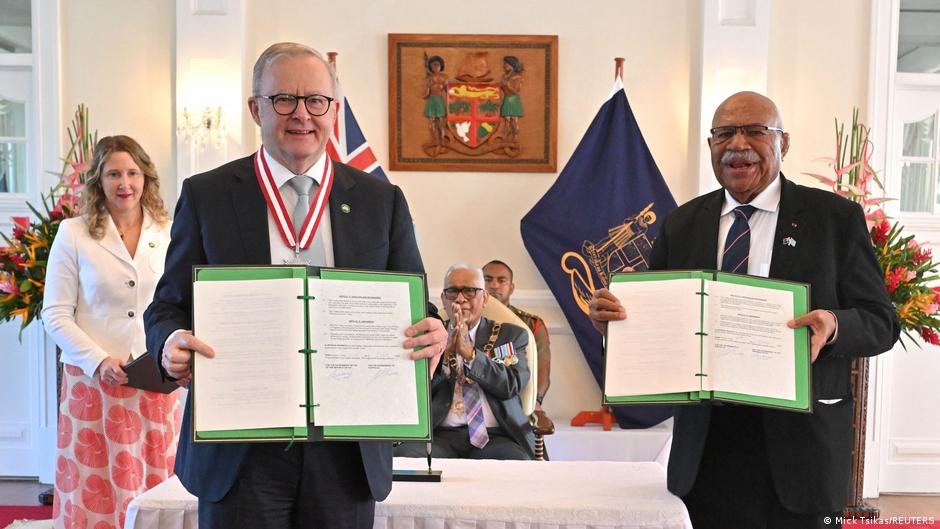
In a pivotal move for regional security, Australia and Fiji have officially entered into a new economic and defense alliance. This agreement, dubbed the 'Ocean of Peace Alliance,' signifies an elevated level of cooperation between the two nations, particularly as Australia seeks to navigate the evolving geopolitical landscape of the Pacific. The pact was signed on Monday by Australian Prime Minister Anthony Albanese and his Fijian counterpart, Sitiveni Rabuka, during a visit to Suva, Fiji's capital.
Prime Minister Albanese underscored the profound nature of this new agreement, stating, "The Ocean of Peace Alliance introduces mutual defense obligations, and there's no higher obligation than to come to each other's aid at a time of need." He further elaborated on the commitment, asserting that "An attack on Fiji from an outside force would trigger Australia's full support for Fiji and for its sovereignty." These statements highlight a robust commitment to collective security, emphasizing the shared interest in maintaining regional stability.
Albanese also used social media to articulate the importance of the visit, noting, "The Pacific is home. And that's why this visit matters for Australians. Tackling shared challenges. Creating new opportunities. Together." This sentiment reflects a broader Australian foreign policy objective of strengthening relationships with Pacific island nations and addressing shared concerns collaboratively.
Understanding the Alliance's Framework
The core of the Ocean of Peace Alliance is a mutual commitment to consult on any "security-related development" that could potentially threaten the sovereignty of either Fiji or Australia. The official text of the agreement states, "The purpose of this treaty is to recognize and affirm the commitment between the parties to protect their sovereignty, secure their mutual defense and security interests and contribute to the stability and security of the Pacific." This clause establishes a formal mechanism for dialogue and coordinated action in response to emerging threats, solidifying a framework for mutual assistance.
Beyond defense, the alliance is also designed to enhance economic ties between the two nations. This dual focus aims to foster comprehensive stability, recognizing that economic resilience often underpins national security. By integrating both defense and economic cooperation, the alliance seeks to create a more robust and self-reliant partnership.
Fiji's Shifting Regional Alignment
Fiji's entry into this alliance marks a significant development in its foreign policy. Australia already maintains defense treaties with key allies such as the United States, New Zealand, and Papua New Guinea. Fiji's inclusion expands this network, particularly given its historical trajectory. Under its former prime minister, Frank Bainimarama, Fiji had cultivated closer ties with Beijing. However, this dynamic began to shift following Sitiveni Rabuka's ascent to power in 2022.
Concerns about potential Chinese military expansion in the Pacific were heightened in 2022 when China signed a security agreement with the Solomon Islands. This accord fueled speculation about China's long-term intentions, with some observers fearing the establishment of a permanent military presence in the region. There were also apprehensions that Fiji might become susceptible to similar overtures. Nevertheless, Beijing's influence in Fiji has reportedly diminished under Rabuka's leadership. In 2025, Rabuka publicly dismissed the notion of Fiji hosting a permanent Chinese military presence, unequivocally stating, "If they want to come, who would welcome them? Not Fiji. And I think that China understands that well." This strong stance underscores Fiji's commitment to its sovereign decision-making regarding its security partnerships.
Regional Developments and Geopolitical Context
The signing of the Ocean of Peace Alliance coincided with reports of China conducting a nuclear-capable ballistic missile test in the South Pacific. Chinese state media, Xinhua, reported the test of a nuclear-capable ballistic missile with a dummy warhead from a submarine, characterizing it as a "routine arrangement." Australian media outlets, including the Sydney Morning Herald and The Australian, indicated that Chinese officials had previously informed regional governments, including Australia, about the impending intercontinental missile test.
Further amplifying the regional maritime activity, data from New Zealand's ship tracking company, Starboard Maritime, indicated the presence of three Chinese satellite-tracking vessels in the Pacific. Two of these vessels were reportedly positioned near the Federated States of Micronesia, with one docked in Suva harbor. Mark Douglas, an analyst at Starboard, commented on the timing, noting that while the test had been planned in advance, "the notification landing the day after Australia and Fiji signed the Ocean of Peace Alliance is interesting, to say the least." China's last reported intercontinental ballistic missile test occurred in 2024. These concurrent events highlight the complex and dynamic geopolitical environment in the Pacific region, underscoring the strategic significance of the newly formed alliance between Australia and Fiji.
Source: Original Article