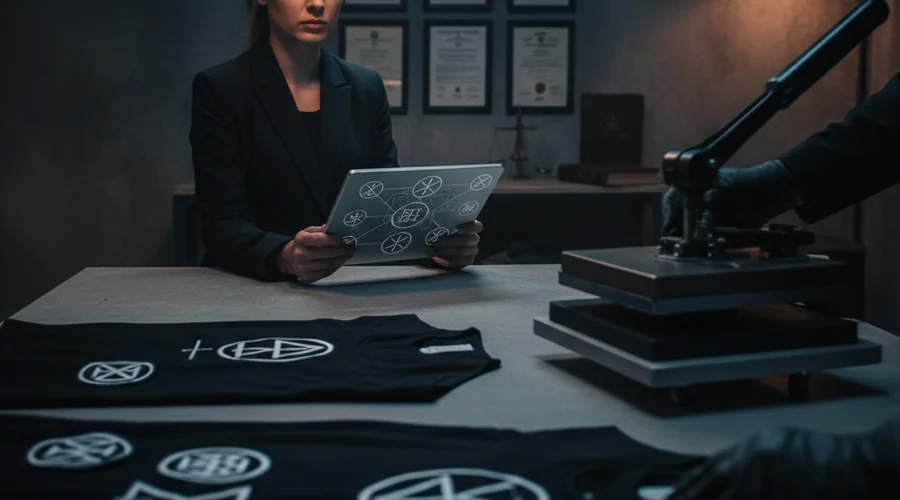
A Novel Approach to Combating Extremist Merchandise
In Germany, where the display of Nazi symbols and propaganda is heavily regulated, a novel strategy is being deployed to challenge vendors of far-right merchandise: the strategic registration of trademarks. This innovative campaign aims to disrupt the financial streams of extremist groups and individuals who profit from selling items bearing coded messages and symbols recognizable within their circles.
For some years, far-right merchandise has served as a significant revenue source for certain right-wing extremist organizations and individuals across Germany. Online platforms facilitate the sale of clothing, accessories, and other products that feature symbols understood by members of the far-right scene. Due to Germany's stringent laws prohibiting overt Nazi symbols, sellers have increasingly resorted to coded language to bypass legal restrictions. For instance, 'Hitler' might appear as 'HTLR,' and 'Hakenkreuz' (swastika) as 'HKNKRZ.'
However, the campaign known as "Recht Gegen Rechts" (Rights Against the Right) has devised an ingenious method to counteract these legal workarounds. They are proactively securing ownership of Nazi-related symbols, coded extremist phrases, and the names of far-right businesses by registering them as trademarks with the European trademark office. Launched in 2021, this initiative is a collaboration between the German creative agency Jung von Matt and the Hamburg-based nonprofit Laut Gegen Nazis (Noise against Nazis).
Should extremist retailers continue to sell products featuring these newly protected names or phrases without authorization, they could face legal repercussions for infringement. This includes potential demands for compensation for each item sold, creating a significant deterrent for their operations.
Disrupting the Online Marketplace
Simon Knittel of Jung von Matt, one of the campaign's founders, highlighted the accessibility of these extremist online shops, stating, "These online shops are not in the darknet; they're existing there online. You have just to find the right URLs." However, for individuals outside the far-right community, locating these stores can be challenging. The campaign benefited from the expertise of Joern Menge, founder of Laut Gegen Nazis, and Philip Schlaffer, a former neo-Nazi and online shop owner who now actively campaigns against far-right extremism.
Schlaffer informed DW that these shops are discoverable if one knows the correct keywords, noting, "A lot of them are now based overseas. It's become a global business where a lot of money is changing hands." The campaign team identified over 35 online stores, each offering more than 1,000 items, and subsequently determined which trademarks would be most effective in disrupting their operations. Schlaffer views the campaign's strategy as both imaginative and impactful. "Neo-Nazis shouldn't feel like they have a safe haven; they should be afraid that the ideas they have — the ones they're selling — might be taken away from them and that the products will need to be taken offline. That takes away their sense of security," he explained.
The immediate impact of this strategy was evident after the first trademark was secured. Knittel recounted, "When we published our initial press release announcing that we had registered a trademark, it only took about 30 minutes, and the trademark was taken down by all the online shops. We didn't have to do anything." He added that the retailers voluntarily removed the items, understanding the legal implications. Subsequent trademark registrations elicited even quicker responses, with items being taken offline within minutes. "In the end, we had to wait just 10 minutes, not 30. That was the proof for us that we found something that really solves the problem," Knittel observed.
Germany's Strict Stance on Extremist Symbolism
Germany's stringent approach to Nazi imagery is rooted in its historical experience and its commitment to preventing any resurgence of National Socialism. Section 86a of the German Criminal Code generally prohibits the display or distribution of symbols associated with unconstitutional organizations. This encompasses symbols of the Nazi Party, including the swastika, SS emblems, and the Nazi salute, although exceptions exist for educational, research, or historical documentation purposes. Violations can lead to substantial fines or even imprisonment, underscoring Germany's position as one of the countries with the strictest laws concerning extremist symbolism globally.
Transforming Extremist Codes into Anti-Fascist Statements
Beyond merely preventing the use of these symbols, Rights Against the Right has advanced its mission by converting neo-Nazi slogans into anti-Nazi merchandise. The campaign successfully trademarked and acquired the web domain of Druck18, a prominent online retailer of neo-Nazi goods operated by far-right extremist Tommy Frenck. This shop previously sold products featuring extremist and xenophobic messages, often appealing to Nazi nostalgia. Recht Gegen Rechts has since replaced it with its own online store, offering anti-Nazi and anti-racist merchandise.
For instance, the new Druck 18 online shop features a sweatshirt with the crossed-out words 'HKN KRZ' (the shorthand for swastika) and the accompanying text: "Thank you trademark law: We've registered this Nazi code as a trademark so Nazis can't spread it." The campaign team had to navigate the challenge of utilizing these new trademarks commercially, as legally required within five years, without inadvertently promoting neo-Nazi rhetoric. Knittel explained their solution: "We had to find a way to make [these Nazi codes] commercially available without contributing to any Nazi scandal or anything like that. So, we turned them upside down and had them written on the shirts."
Challenges and Ongoing Efforts
The campaign has successfully secured six trademarks and is in the process of obtaining more. The trademark registration process is complex, often taking up to six months and costing approximately €1,600 ($1,823) per trademark, with no guarantee of approval. The initiative is entirely reliant on donations, and Jung von Matt contributes its services pro bono. The team has also faced harassment, including hate mail, and is currently seeking individual name donors, as each trademark must be registered under a person's name.
Furthermore, the campaign is engaged in a legal dispute with Tommy Frenck, the original owner of Druck18, who sought a court order to prevent them from using the shop's name but lost in both initial and appeal court proceedings. Despite these successes, some neo-Nazi codes cannot be protected by trademark law, leaving gaps in their defensive strategy. Knittel acknowledged, "So, there are still codes out there that we can't protect against." Nevertheless, he emphasized the overarching goal: "But in the end, the goal was to create awareness that these codes exists," both among the public and within political spheres. Through its persistent efforts, Rights Against the Right has undoubtedly achieved this awareness, one trademark at a time.
Source: Original Article