AfD Concludes Conference with Governmental Aspirations
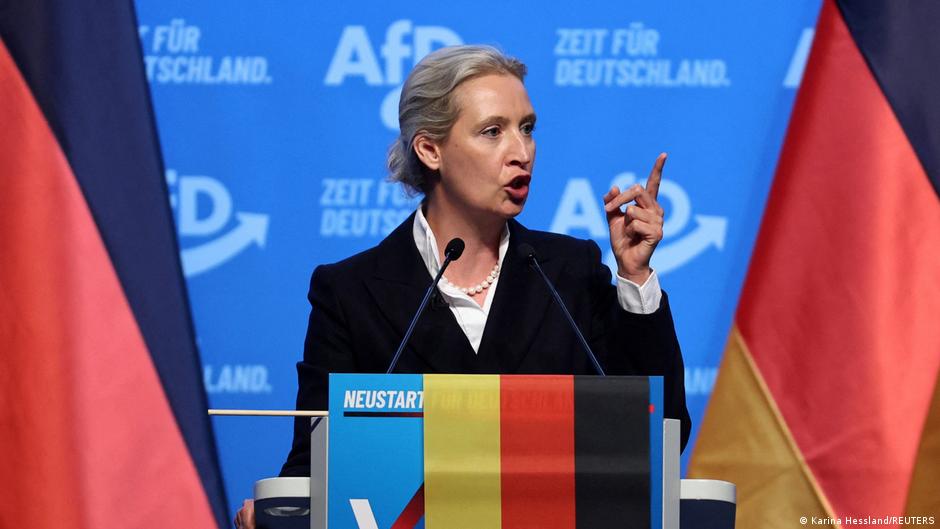
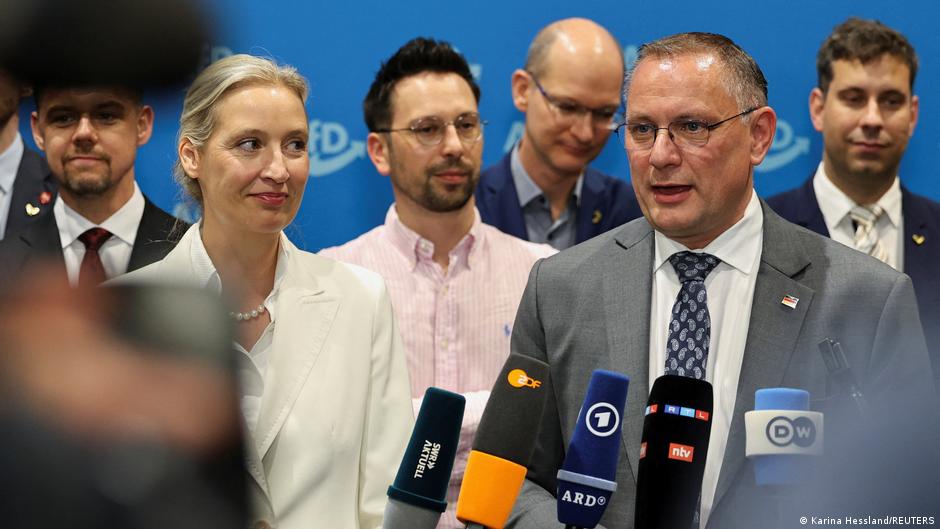
The Alternative for Germany (AfD) party concluded its two-day conference in Erfurt, with leaders reiterating their ambition to enter government at both state and federal levels. Co-leaders Alice Weidel and Tino Chrupalla emphasized their party's readiness to govern, with Weidel rallying members around a nationalist platform and Chrupalla urging party unity in the pursuit of power. The party's immediate goals include winning state elections in Saxony-Anhalt, Mecklenburg-Western Pomerania, and Berlin in September, with a long-term aim to secure federal power by 2029.
Despite recent opinion polls suggesting the AfD as the most popular party in Germany, a significant political barrier, often referred to as the 'Brandmauer' or 'firewall,' prevents cooperation from other established parties. The conference also highlighted internal dynamics and external scrutiny. Weidel, for instance, addressed criticism regarding the party's traditional family policy, stating that while she personally lives in a same-sex relationship with children, the party's broader advocacy for a traditional family model remains a political goal. The AfD continues to face monitoring by German domestic intelligence services due to concerns over its ethnic nationalist views, which are considered potentially unconstitutional. The conference took place amidst ongoing protests against the far-right party, and its ambitions are set against a backdrop of past controversies, including a senior figure's Hitler salute and questioning the 'Germanness' of non-white national team players.
Finance Minister Defends Increased National Debt
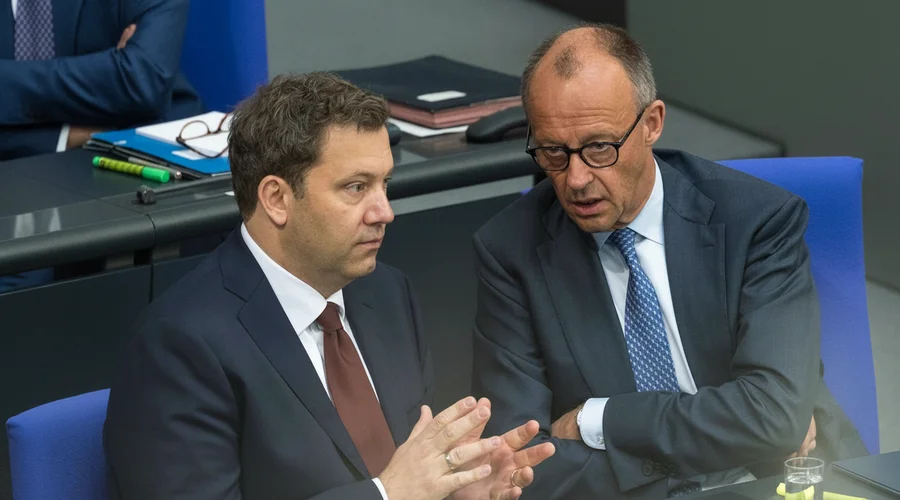
Germany's Finance Minister Lars Klingbeil, a member of the Social Democratic Party (SPD), publicly defended the government's proposal for a significant increase in national debt within the draft budget for 2027. Klingbeil attributed the necessity for higher borrowing to a combination of international conflicts. He cited the 'Iran war' as a factor that has curtailed economic growth prospects and highlighted the ongoing impact of 'Russia's full-scale invasion of Ukraine' as a key driver for increased defense spending. The minister stressed that investments in national defense against potential risks from Russia cannot be achieved without an expanded budget. The proposed 2027 budget draft is scheduled for a cabinet vote on Monday.
Cologne Hosts Massive Pride Parade
The city of Cologne witnessed one of Germany's largest Christopher Street Day (CSD) parades, or Pride parades, attracting an estimated 1.5 million participants and spectators. Organizers reported approximately 60,000 individuals registered for the parade, which featured around 100 floats traversing the city center. Cologne is recognized as a significant hub for LGBT+ culture in Germany and Europe. The event's slogan, 'For Queer Rights — Many. Together. Strong!', underscored its advocacy for the rights and causes of the queer community. Herbert Reul, the Interior Minister of North Rhine-Westphalia, the state encompassing Cologne, participated in the parade for the first time. Reul expressed his concern over rising homophobic sentiment in society, emphasizing that the police are committed to protecting all individuals regardless of their lifestyle. Former Culture Minister Claudia Roth of the Green Party described the parade as the 'largest demonstration for democracy' in Germany, while former Health Minister Karl Lauterbach (SPD) highlighted the critical importance of CSD in the face of increasing pressures from right-wing ideologies.
Germany Bids to Host 2029 Tour de France Opening
Germany has formally submitted a bid to host the 'Grand Depart,' or opening stages, of the 2029 Tour de France. This move advances an earlier plan to bid for the 2030 event. Rudolf Scharping, a bid board member and former defense minister, confirmed the submission, outlining a proposed route that could involve Berlin and the federal states of Saxony, Saxony-Anhalt, and Thuringia. The envisioned German leg, estimated to cost around €25 million ($29 million), would coincide with the 40th anniversary of the fall of the Berlin Wall. Proposed stages include a start at Berlin's Brandenburg Gate, passing iconic landmarks, and additional routes from Dresden to Jena, Erfurt to Magdeburg, and Halle to Leipzig. While Tour de France director Christian Prudhomme has indicated openness to an eastern German start, the bid faces competition from Slovenia and the Czech Republic. Germany has previously hosted the Grand Depart on four occasions: Cologne in 1965, Frankfurt in 1980, West Berlin in 1987, and Düsseldorf in 2017.
Source: Original Article