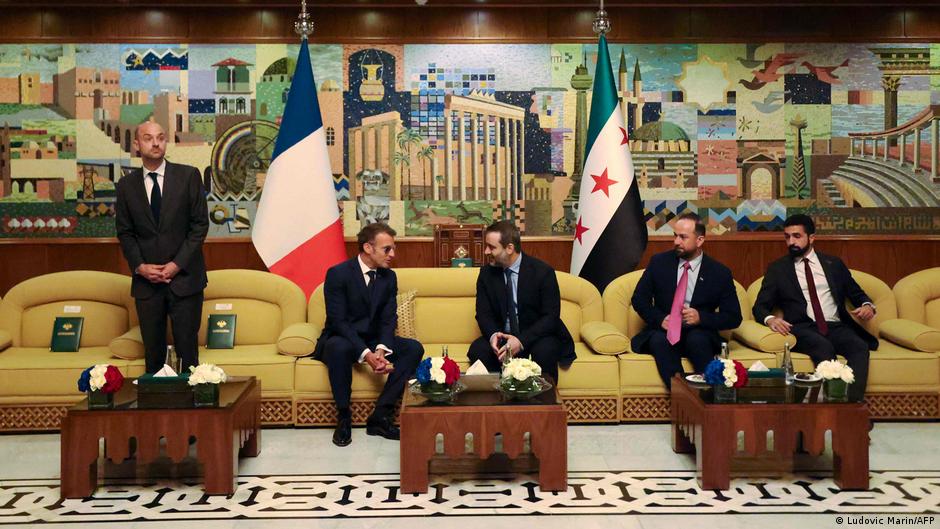
A New Chapter in Syrian-European Relations
French President Emmanuel Macron arrived in Damascus on Monday evening, marking a significant diplomatic event as he became the first leader from the European Union to visit Syria since the dramatic shift in the nation's political landscape. His arrival follows the unexpected downfall of Bashar al-Assad's government and the ascent of Ahmed al-Sharaa, a former militant leader who has transitioned into the presidency.
This visit signals a potential recalibration of international relations with Syria, particularly from European nations that had largely distanced themselves from the country during Assad's protracted rule and the subsequent civil conflict. Macron's presence in Damascus is likely to be viewed through various lenses, both domestically within France and across the international community, as a gesture that could either pave the way for broader engagement or draw criticism regarding the legitimacy of the new Syrian administration.
The Post-Assad Era: A Shifting Political Landscape
The political environment in Syria has undergone profound changes in the last 18 months. The sudden and largely unforeseen collapse of the Assad regime created a power vacuum that was swiftly filled by new leadership. Ahmed al-Sharaa, whose background includes a period as a prominent militant figure, has since assumed the presidency. This transition has been met with a mix of anticipation and apprehension globally, as observers assess the implications for regional stability and the future of governance in Syria.
The international community has been grappling with how to engage with this new Syrian reality. For many years, diplomatic isolation was the prevailing stance against the Assad government due to widespread accusations of human rights abuses and the brutal suppression of dissent. Macron's visit suggests a potential deviation from this established policy by at least one major European power, prompting questions about whether other EU member states might follow suit or maintain their current distance.
Macron's Diplomatic Calculus
President Macron's decision to travel to Damascus likely stems from a complex set of considerations. France, like many European nations, has a vested interest in the stability of the Middle East, particularly concerning issues such as migration, counter-terrorism, and regional security. Engaging directly with the new Syrian leadership could be seen as a pragmatic step towards addressing these concerns, even if it means acknowledging a government that emerged from a militant background.
Furthermore, the visit might be an attempt to reassert European influence in a region where other global powers, including Russia and Iran, have historically played significant roles. By establishing early contact with President al-Sharaa, France could be positioning itself to have a voice in Syria's reconstruction and future political development, potentially advocating for French interests and European values.
Challenges and Opportunities
The path forward for Syria under its new leadership is fraught with challenges. The country faces immense humanitarian needs, extensive infrastructure damage, and the lingering effects of years of conflict. Any international engagement, including visits from high-profile leaders like Macron, will inevitably raise expectations for assistance and cooperation in rebuilding the nation.
However, opportunities for renewed diplomatic efforts also exist. A stable and functional Syrian state is arguably in the interest of the wider international community. Macron's visit could be a preliminary step towards assessing the intentions and capabilities of the al-Sharaa administration, and potentially identifying avenues for constructive engagement that could benefit the Syrian populace and contribute to regional peace.
International Reactions and Future Implications
The international community's reaction to Macron's visit is expected to be varied. Some nations might view it as a necessary and pragmatic step towards normalizing relations and addressing pressing issues in Syria. Others might express reservations, particularly given the background of President al-Sharaa and the lack of a clear, internationally recognized transitional process.
The long-term implications of this visit remain to be seen. It could mark the beginning of a broader European re-engagement with Syria, or it could remain an isolated diplomatic initiative. Nevertheless, President Macron's presence in Damascus undeniably signifies a new phase in Syria's post-Assad era, compelling the world to re-evaluate its approach to a nation undergoing profound transformation.
Source: Original Article