Anish Kapoor's Distinctive Artistic Vision
Anish Kapoor, an artist renowned for pushing the boundaries of perception, is currently featured in two significant exhibitions. His work frequently challenges viewers with optical illusions, shifting perspectives, and an engagement with profound themes, sometimes leading to a sense of disquiet or introspection. These new showcases offer an opportunity to re-examine the extensive oeuvre of an artist whose creations often elicit strong, visceral reactions.
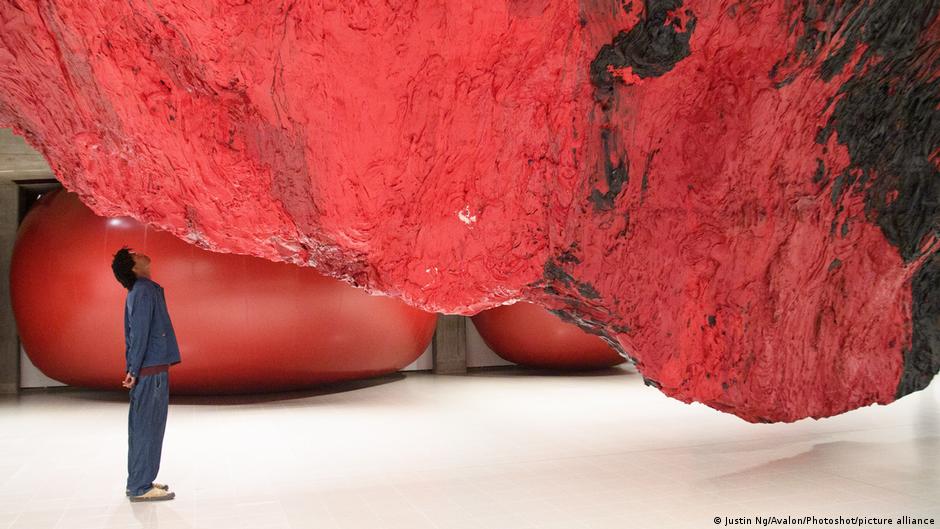
Kapoor's art can be demanding for its audience. For instance, some of his installations involve gazing into seemingly endless dark voids or confronting the intense blackness of materials that absorb almost all light. This can be unsettling for some, depending on their individual state of mind. Another recurring element in his work is the use of dark red wax, a material he frequently employs to evoke associations with flesh and blood, aiming to create a direct, core impact on the viewer.
Despite the often-intense nature of his art, Kapoor himself presents as amiable and composed when discussing his creations. However, even he admits to moments of unease with his own pieces. During an interview with ARD at his major exhibition at the Lehmbruck Museum in Duisburg, Germany, Kapoor interacted with 'First Body,' a resin sculpture. He described it as 'fleshy' and chuckled, acknowledging the peculiar sensation it evoked in him.
The Creative Process: Embracing the Unknown
One potential reason for Kapoor's strong personal reactions to his installations may lie in his creative methodology. He often begins working with materials without a predetermined outcome. In an interview with The Talks magazine, he described his studio process: 'I go into the studio and say, 'I don't know what to do. I'm lost.' Then stuff arises and it's the thing in the room that you work with.' He expressed a deep interest in this process, noting that it guides him in directions that rational thought alone could not achieve.
A Global Artistic Presence
Born in Bombay (now Mumbai), India, in 1954, Anish Kapoor has achieved international recognition, establishing himself as one of the most prominent and sought-after contemporary artists globally. His distinguished career includes winning the prestigious Turner Prize in 1991 and being knighted by Queen Elizabeth II in 2013. Having resided in London for over five decades, the Hayward Gallery is now dedicating a significant exhibition to his work.
Kapoor's art is not confined to galleries; many of his pieces are permanently installed in public spaces worldwide, seamlessly integrating with both urban landscapes and natural environments. A notable example is 'Cloud Gate,' affectionately known as 'The Bean,' which has been a fixture in Chicago's Millennium Park since 2006. This colossal, bean-shaped stainless-steel sculpture famously reflects the city's skyline, becoming an iconic landmark.
Another of his prominent public works is 'HOWL,' a massive PVC sphere installed in the rotunda of Munich's Pinakothek der Moderne since 2020. Kapoor has stated that the reddish-brown hue of 'HOWL' intentionally references menstrual blood, further demonstrating his engagement with primal and bodily themes. He often speaks of his fascination with the color red, describing it as possessing 'a frightening kind of darkness.'
Exploring the Depths of Black
Kapoor's exploration of color extends to its absolute opposite: black. In 2016, he acquired exclusive rights to Vantablack, a material considered the blackest ever created. Developed through nanotechnology, primarily for military applications, Vantablack absorbs approximately 99.6% of incident light. When objects are coated with this material, the human eye struggles to perceive the minimal reflected light, causing them to appear devoid of texture, wrinkles, or contours. This creates an illusion of a two-dimensional, infinitely deep void in space.
Reflecting on Vantablack in 2016, Kapoor told BBC Arts, 'It's as dark as you can imagine, so dark that you lose your sense of who you are and where you are and especially your sense of time.' This immersive quality is central to his work with the material.
The Void: A Central Theme and an Unforeseen Incident
Kapoor's artistic manipulation of such deceptive materials led to an unusual incident in 2018 at the Serralves Museum in Porto. A visitor, misinterpreting a Vantablack-coated surface as solid ground, stepped into what was an actual 2.5-meter (over 8-foot) deep void. The artwork, aptly titled 'Descent into Limbo,' resulted in only minor injuries for the individual.
The concept of the void has been a longstanding and fundamental theme in Kapoor's artistic practice. While Western philosophy often defines 'the void' as an absence or lack, Kapoor's understanding is deeply informed by Eastern philosophical traditions, particularly Hinduism and Buddhism. For him, the void represents the origin point of all existence, an expansive realm brimming with possibilities, promises, and nascent forms.
Beyond the Instagram Frame
Kapoor intentionally designs his works to evoke a sense of vertigo or falling, although not necessarily in a literal downward trajectory. At an exhibition at London's Tate Modern, he explained that his creations embody the act of falling, clarifying that 'falling doesn't have to be downwards. The falling in some curious way could also be towards a horizon or even upwards. Vertigo is at the center of this though — disorientation.'
While many contemporary artworks are often shared on platforms like Instagram, Kapoor's pieces, despite their visual impact, are not always easily captured through a smartphone lens. Unlike the readily photographable works of artists such as Yayoi Kusama or Jeff Koons, Kapoor's art often requires direct, unmediated engagement to fully appreciate its power and immersive qualities, emphasizing an experience that transcends digital representation.
The exhibition at the Lehmbruck Museum in Duisburg is open until August 30, 2026, while the Hayward Gallery in London will showcase Kapoor's works through October 18, 2026.
Source: Original Article