Celebrating Three-Quarters of a Century: The Goethe-Institut's Enduring Mission
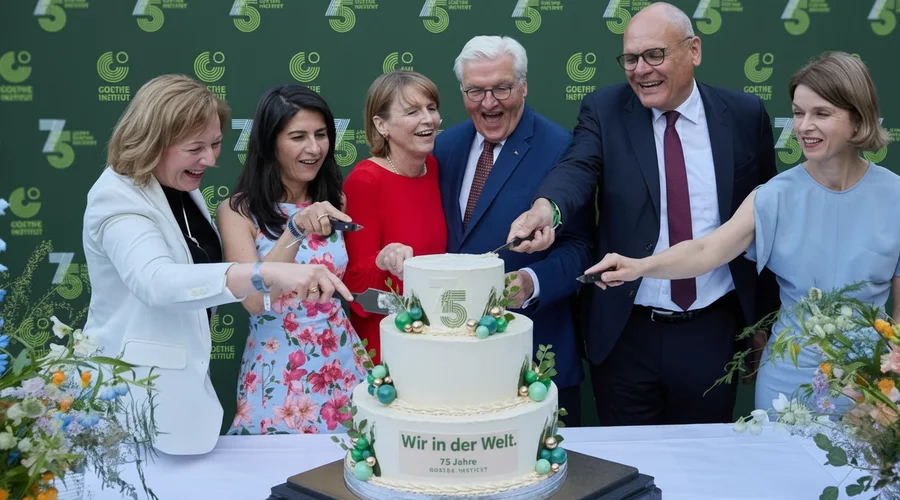
The Goethe-Institut, Germany's esteemed cultural institution, recently commemorated its 75th anniversary, marking decades of dedicated work in promoting German language, culture, and fostering international dialogue. Established in 1951, the institute has evolved from a post-war initiative focused on rebuilding Germany's global image to a dynamic network operating in over 100 countries. The anniversary celebration saw prominent figures, including German President Frank-Walter Steinmeier, underscore the vital role of cultural diplomacy in an increasingly complex world.
President Steinmeier Advocates for Enhanced Support
During the anniversary ceremony in Berlin, President Steinmeier lauded the Goethe-Institut's historical significance and its ongoing contributions. He emphasized that the institution's founding reflected the vision and courage of the Federal Republic's progenitors, who sought to conduct cultural work abroad with a spirit of freedom – a model he described as uniquely worldwide. Steinmeier called upon the Bundestag and society at large to provide robust support for the Goethe-Institut, stressing the need for a stable financial foundation and advocacy against forces that seek to undermine diversity and openness in cultural and educational policies. He articulated a foreign policy framework for non-major powers like Germany, comprising military strength, astute diplomacy, an international legal order, and crucially, culture and science as forms of 'soft power' offered to the global community.
From Post-War Rebuilding to Global Network
The Goethe-Institut's origins are deeply intertwined with Germany's post-World War II efforts to regain international trust and re-establish its cultural presence after the atrocities of National Socialism. Initially founded as 'Goethe e.V. zur Fortbildung ausländischer Deutschlehrer' (Goethe Association for the Further Training of Foreign German Teachers), its primary aim was to invite foreign German language educators to Germany for training. This focus soon broadened to include teaching German abroad. The first international branch opened in Athens in 1952, and within a decade, 54 branches were operational globally, significantly outpacing the 17 within Germany itself. Today, the Goethe-Institut boasts a vast international network of 154 locations across 100 countries, employing nearly 4,400 staff. Annually, approximately one million individuals undertake official German language examinations through the institute or its partner organizations.
Evolving Cultural Mandate and Adaptability
A cornerstone of the Goethe-Institut's enduring success has been its credibility as an independent association. Despite receiving two-thirds of its funding from Germany's Foreign Office, the institute maintains programmatic autonomy, allowing it to adapt its offerings to contemporary societal and political contexts. Early efforts concentrated on showcasing classical German culture, leveraging the international appeal of figures like Schiller, Bach, and Beethoven. By the 1960s, its cultural exports diversified to include German jazz and literature, featuring Nobel laureates such as Günter Grass, Heinrich Böll, and Herta Müller. The social upheavals of 1968 prompted the institute to engage more deeply with socio-political issues, including a critical examination of Germany's Nazi past.
Gesche Joost, President of the Goethe-Institut since 2024, clarified that the institute's mission was never merely about exporting German culture. Instead, it was about initiating a fresh start and fostering collaborative societal and future-oriented discussions. This shift reflected a move away from cultural export towards principles of dialogue, cooperation, and mutual learning, which continue to define its approach today.
Navigating Geopolitical Challenges and Crisis Regions
Throughout the Cold War, the Goethe-Institut found itself embroiled in the cultural diplomacy competition between East and West Germany, even facing unfounded accusations of espionage from East German media. Following the fall of the Iron Curtain in 1989, the institute expanded rapidly into Eastern Europe and former Eastern Bloc countries, including Moscow. More recently, geopolitical events have presented new challenges. While Russia's Foreign Ministry ordered a reduction in the institute's staff, its operations there persist. Similarly, the Kyiv institute in Ukraine has remained open throughout the ongoing conflict, offering a flexible, hybrid model for language courses that adapts to air-raid alerts by moving classes to shelters.
Joost highlighted that working in crisis situations has become a pervasive aspect of the institute's global outreach, whether due to restrictions on democracy, censorship, or armed conflict. She emphasized the Goethe-Institut's role as a crucial partner for civil society in these regions, necessitating sensitivity and diplomatic acumen to avoid forced closures. The institution remains dedicated to providing platforms for open debate and critical reflection. However, Germany's stance on the Middle East conflict has recently complicated its work, leading to boycotts and suspended collaborations in some parts of the Arab world, amid criticisms concerning the suppression of pro-Palestinian advocacy. Joost affirmed the institute's commitment to explaining Germany's position and internal debates, while also relaying international criticisms back to Germany.
Addressing Funding Cuts and Future Roles
In recent years, the Goethe-Institut has contended with significant federal funding cuts, leading to a restructuring that included the closure of some branches. Despite these challenges, Joost envisions a pivotal role for the institute in Germany's efforts to integrate a growing number of international skilled workers. Recognizing that settling in Germany can be complex, the institute offers guidance for newcomers on living and working in the country. The 75th-anniversary celebrations, held under the motto 'Wir in der Welt' ('We in the World'), include a global program of concerts, performances, film series, and discussion events, underscoring its continued commitment to worldwide engagement.
Source: Original Article