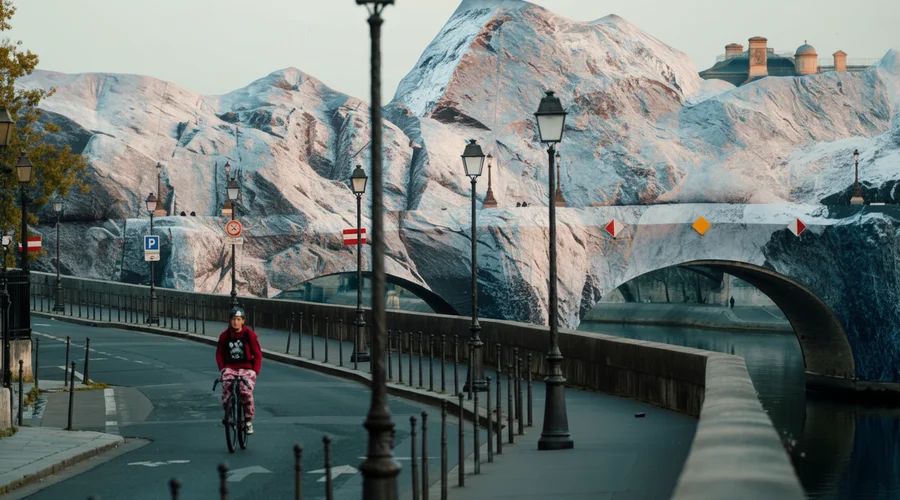
A Grand Scale Illusion in the Heart of Paris
The renowned French street artist, known as JR, has recently inaugurated a monumental art installation in Paris, transforming one of the city's most recognizable bridges into a cavernous optical illusion. This ambitious project, which experienced a slight delay due to weather conditions, serves as a profound tribute to the late artistic duo Christo and Jeanne-Claude, specifically referencing their celebrated 1985 work, 'The Pont Neuf Wrapped.'
JR's installation, located on the Pont Neuf, Paris's oldest standing bridge, invites onlookers to perceive the structure in an entirely new light. Through a masterful application of trompe l'oeil techniques, the artist creates a visual paradox, making the solid stone bridge appear as if it is enveloped within a vast, shadowy grotto. This play on perception is characteristic of JR's artistic approach, which often involves large-scale photographic collages that alter urban landscapes and challenge conventional viewpoints.
Connecting Past and Present Artistic Vision
The choice of the Pont Neuf for this installation is particularly significant, directly linking JR's contemporary work to Christo and Jeanne-Claude's historical intervention. In 1985, Christo and Jeanne-Claude famously wrapped the entire Pont Neuf in a sand-colored polypropylene fabric, a project that took 10 years of negotiations and planning to realize. Their work was not merely about aesthetic transformation but also about the temporary nature of art, the process of creation, and the dialogue it sparked with the public and the urban environment. JR's current project, while distinct in its method and visual outcome, resonates with these core themes, offering a fresh interpretation of how public spaces can be reimagined through art.
JR's artistic practice frequently involves engaging with public spaces and often uses photographic prints to create illusions or to highlight social issues. His work has graced various global landmarks, from the favelas of Rio de Janeiro to the Louvre Museum in Paris. The current bridge installation further solidifies his reputation for creating accessible, thought-provoking art that interacts directly with its surroundings and audience.
The Technicalities Behind the Illusion
The creation of JR's optical illusion on the Pont Neuf involved meticulous planning and execution. Large-format photographic prints, carefully designed to distort perspective, were affixed to the bridge's facade. These prints, when viewed from specific vantage points, seamlessly blend with the bridge's architecture, creating the illusion of depth and an interior space where none exists. The technique relies on precise measurements and understanding of light and shadow to achieve its convincing effect. The temporary nature of the installation, much like Christo's projects, adds to its unique appeal, emphasizing the fleeting beauty of artistic intervention in public spaces.
"My work is always about creating an illusion, about challenging perceptions," JR stated in a past interview. "This project is a continuation of that, but with a direct nod to artists who inspired me deeply."
Public Reaction and Artistic Dialogue
The installation has garnered considerable attention from both Parisians and tourists alike. The element of surprise and the sheer scale of the transformation encourage interaction and discussion, fulfilling one of the primary goals of public art. Visitors are prompted to pause, observe, and question their perception of reality and the familiar urban landscape. This engagement is crucial, as it fosters a dialogue not only about JR's art but also about the legacy of Christo and Jeanne-Claude, introducing their groundbreaking work to a new generation of art enthusiasts.
The project underscores the ongoing evolution of street art and public installations, demonstrating how contemporary artists continue to draw inspiration from their predecessors while forging new paths. By transforming an iconic Parisian landmark, JR not only pays homage to a significant artistic legacy but also reaffirms the power of art to alter perceptions and enrich the urban experience, even if only for a limited time.
Source: Original Article