
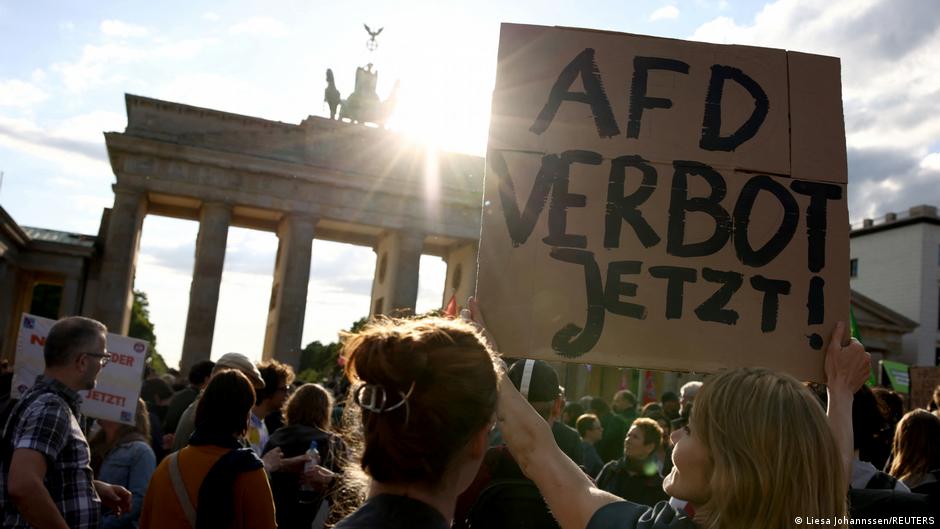
Comprehensive Legal Review Highlights AfD's Alleged Unconstitutionality
A new report by the Society for Civil Rights (GFF) has reignited the debate surrounding a potential ban on Germany's far-right Alternative for Germany (AfD) party. The legal assessment, unveiled this week, concludes that the AfD is "demonstrably unconstitutional," suggesting that legal action to prohibit the party could ultimately succeed. This finding emerges from an extensive year-long investigation conducted by a team of legal experts and researchers, who meticulously analyzed 77,000 parliamentary documents, 55,000 press releases, and 2.9 million social media posts related to the AfD. The GFF, an organization originally co-founded by a Green Party politician and comprising a board of lawyers and law professors, asserts that its report represents the most comprehensive evaluation to date regarding the AfD's constitutionality.
Project leader Bijan Moini, presenting the GFF report in Berlin, articulated the core arguments for the AfD's unconstitutionality. He stated that the party actively "opposes the principle of democracy by seeking to suppress its political opponents" and also "opposes human dignity because its racially charged political concept, much like that of the NPD, establishes different classes of people." Moini emphasized that the Federal Constitutional Court has previously clarified that if a party undermines any of the three defining characteristics of the free democratic order—human dignity, democracy, or the rule of law—it effectively opposes the entire framework. The GFF believes the AfD meets these criteria.
Evidence of Alleged Unconstitutional Practices
Moini pointed to several specific aspects of the AfD's rhetoric and proposed policies as evidence. He argued that the party's public statements reveal a racist interpretation of German citizenship, which in itself could be deemed unconstitutional. Crucially, Moini stressed that it is not merely the existence of such a concept within the AfD, but the party's intention to implement it, that makes it problematic under the Basic Law. Furthermore, the GFF report highlights instances where AfD members have made threats against governing politicians, suggesting an attack on democratic processes. Moini cited examples where the party has called for "prison sentences for decisions that it does not agree with politically." He interprets this as an ideology that views political opponents not as equal participants in democratic competition, but as "traitors to the people."
The report provides concrete examples to support these claims. For instance, AfD co-leader Alice Weidel’s 2019 promise to "personally ensure that [former Chancellor] Angela Merkel ultimately ends up in court" is cited. Similarly, Stephan Brandner, a prominent AfD member of the Bundestag, was quoted from 2022 stating that a "feisty justice minister and a feisty prosecutor" would eventually target both Merkel and her successor, Olaf Scholz. Moini argues that the basis for these demands is not potential criminal offenses, but rather democratically legitimate decisions concerning various policy areas such as migration, the COVID-19 pandemic response, the nuclear phaseout, and Ukraine policy. These statements, the GFF contends, are sufficient to demonstrate the AfD's alleged unconstitutionality.
Political Landscape and Historical Precedents
Despite the GFF's strong legal arguments, any attempt to ban the AfD would inevitably be politically charged. The party currently holds significant popularity in Germany, with some polls indicating up to 29% nationwide support, making it the most popular political party. A ban could only be initiated if a motion is filed with the Federal Constitutional Court by one of three constitutional bodies: the federal government, the Bundestag, or the Bundesrat. However, there appears to be a lack of political consensus for such a move at present. In January 2025, during the last Bundestag discussion on the issue, only 124 out of 733 members supported calling for a ban. Both the conservative Christian Democratic Union (CDU) and many members of the center-left Social Democratic Party (SPD) have expressed opposition to pursuing a ban.
Rolf Frankenberger, director of the Institute for Right-Wing Extremism Research at Tübingen University, acknowledged the significance of the GFF report. He stated that "from a social science perspective, this provides more than sufficient evidence of the ideologies driving the AfD and that these are incompatible with the Basic Law." However, Frankenberger also conceded that the current political climate is not conducive to a ban, noting that "at the moment, it does not seem realistic that a ban proceeding will take place, as the CDU/CSU in particular is opposed to it." He suggested that it is primarily up to the CDU/CSU, and parts of the SPD, to reconsider their resistance.
Historically, attempts to ban political parties in Germany have faced challenges. The example of the National Democratic Party of Germany (NPD), a party with neo-Nazi elements, is often cited. Two previous attempts to ban the NPD, most recently in 2017, were unsuccessful. Nevertheless, the GFF remains confident that a proceeding to ban the AfD could be successful, distinguishing their case based on the specific criteria and evidence presented.
Reactions and Future Implications
AfD co-leader Alice Weidel has dismissed the GFF report, criticizing its methodology, particularly the use of AI system Claude Opus for analyzing some AfD officials' statements, despite the report clarifying that human review corroborated the AI analyses. Weidel characterized the report as an "AI-generated" and "far-fetched" attempt by other parties to undermine the AfD. Conversely, the 'Ban the AfD Now' campaign, launched in June 2024, views the report as a significant boost to its cause. Campaign spokesperson Felix Jochim stated, "Now we have it in black and white: The AfD must be banned because — on legal grounds — it is unconstitutional. Politicians have no more excuses." The Amadeu Antonio Foundation, an anti-racist NGO, also supports a ban, with chairman Timo Reinfrank asserting that "The AfD is the greatest threat to our democratic coexistence." Several politicians, including Baden-Württemberg's newly-elected State Premier Cem Özdemir of the Green Party, have echoed these sentiments, suggesting the GFF's expert opinion confirms the AfD's dangerous nature. Frankenberger concluded that even an attempt to ban the party would at least provide legal clarity and necessitate a broader societal discussion on democracy and human rights.
Source: Original Article