Overview of Mounting Tensions
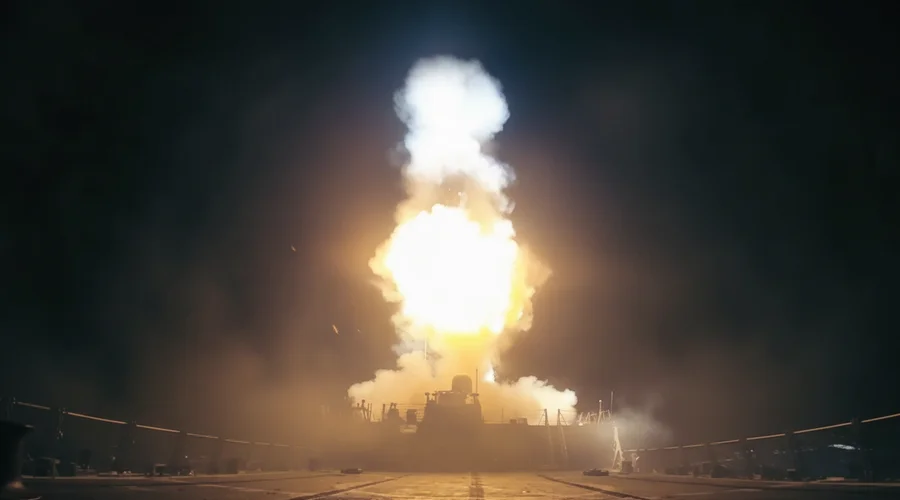
The United States military has confirmed a new sequence of strikes against targets within Iran, a development occurring as a renewed blockade on Iranian ports comes into effect. This escalation follows a period of heightened friction between the two nations, with Washington stating its actions are intended to "continue degrading Iranian capabilities." Conversely, Tehran has articulated that the imposition of the new blockade effectively "dismantles" the existing truce agreement that had been brokered between the two countries.
Reports from Iran's official news agency, IRNA, indicated that a location on Hengam Island was struck by projectiles attributed to an "American enemy." Additionally, the semi-official Mehr news agency reported the activation of air defense systems around the Bushehr nuclear power plant. Unspecified explosions were also reported in the towns of Bampur and Chabahar, although Iranian officials subsequently denied these particular reports. These incidents unfolded shortly after the U.S. military's announcement of its latest round of offensive actions.
Naval Blockade and Iranian Response
The U.S. military has commenced a naval blockade of Iranian ports, marking the second such measure implemented this year. An earlier blockade had been lifted in June following a memorandum of understanding (MoU) between Washington and Tehran. Initially, U.S. President Donald Trump had proposed a 20% fee for vessels transiting the Strait of Hormuz under U.S. military protection. However, this demand was later rescinded, reportedly due to appeals from allied nations in the Gulf region.
Iranian Deputy Foreign Minister Kazem Gharibabadi stated that the U.S. naval blockade effectively "dismantles" the agreement facilitated by Pakistan between the two countries. He asserted that President Trump's decision had, in essence, invalidated the "Islamabad memorandum," thereby releasing Iran from its commitments under the MoU. Gharibabadi further emphasized Iran's unwavering commitment to exercising its sovereignty over the Strait of Hormuz, which he described as integral to the nation's security.
U.S. Military Justification for Strikes
U.S. Central Command (USCENTCOM) confirmed the initiation of new strikes against Iran, specifying their purpose: "to continue degrading Iranian capabilities used to attack commercial shipping in the Strait of Hormuz." This military action preceded the scheduled implementation of the U.S. naval blockade on Iranian ports and coastal areas. Unnamed U.S. officials, cited by Reuters and the Associated Press, indicated that the strikes were designed to neutralize "emerging threats," though specific details were not provided.
Regional Repercussions and International Reactions
The escalating conflict has had wider regional implications. In Yemen, Houthi forces claimed to have shot down a Saudi drone over the Al-Bayda Governorate, marking a significant increase in hostilities since a 2022 truce. Concurrently, rocket sirens were activated across Bahrain, with the country's Interior Ministry advising citizens to seek safety, attributing the threats to Iranian retaliatory actions against U.S. strikes.
Internationally, India lodged a "strong protest" with Tehran following a deadly attack on two tankers in the Strait of Hormuz, which resulted in the death of an Indian mariner and injuries to others. India's Foreign Ministry condemned attacks on commercial shipping and called for an end to violence targeting seafarers and disrupting free navigation in international waterways. The United Arab Emirates also reported that two Ukrainian nationals were injured in the cruise-missile attack.
Political Statements and Legislative Developments
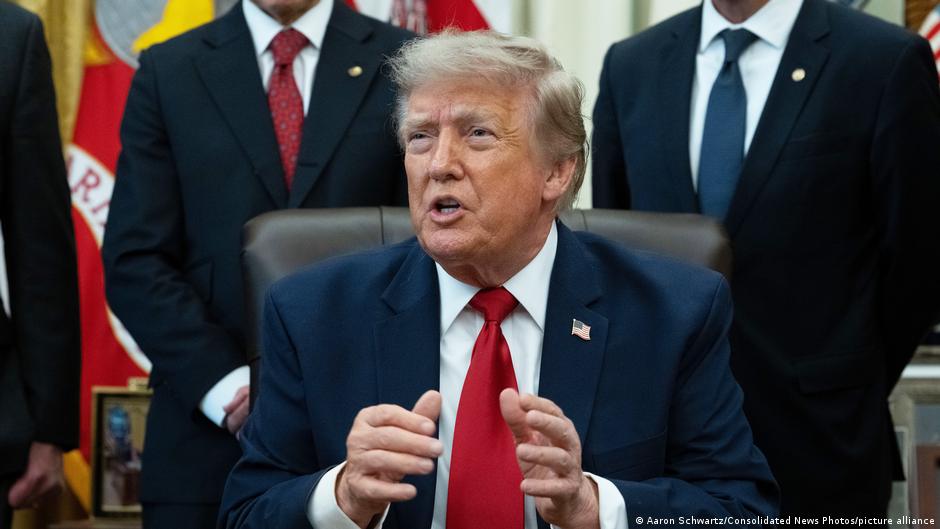
President Trump, in a statement on his Truth Social platform, reiterated that the Strait of Hormuz remained open to all ship traffic except for Iran. He announced a "FULL Blockade" on vessels connected to Iranian ports or cargo, while also retracting the earlier proposal for a 20% fee for passage through the Strait. Instead, Trump indicated that the U.S. would pursue trade and investment deals with Gulf Arab states, describing these as "massive" and mutually beneficial.
Furthermore, President Trump suggested that the U.S. Congress might incorporate Iran and Hezbollah, the Lebanon-based Islamist militia, into a Russia sanctions bill. He framed this as a significant legislative move, honoring the late Republican Senator Lindsey Graham's advocacy for such measures.
In other diplomatic developments, Iran's Foreign Ministry criticized the United Kingdom's proposal to ban support for the Islamic Revolutionary Guard Corps (IRGC), labeling it a breach of international law. Tehran asserted that the IRGC is a legitimate state institution and accused the UK of an "unjustified" and "irresponsible" move. The proposed UK legislation aims to counter foreign states using proxies for hostile activities.
Meanwhile, Israeli Prime Minister Benjamin Netanyahu issued a stern warning to Iran, stating that Israel would retaliate decisively if attacked. He declared that the era of unpunished aggression against Israel was over, reinforcing the joint U.S.-Israeli stance in the conflict that began on February 28.
Source: Original Article