German Government Introduces Broad Economic Reforms
Following its inaugural year in office, Germany's coalition government has announced a wide-ranging set of reforms designed to stimulate the country's economy. The proposals, presented after extensive negotiations, have generated varied responses from different sectors of society.
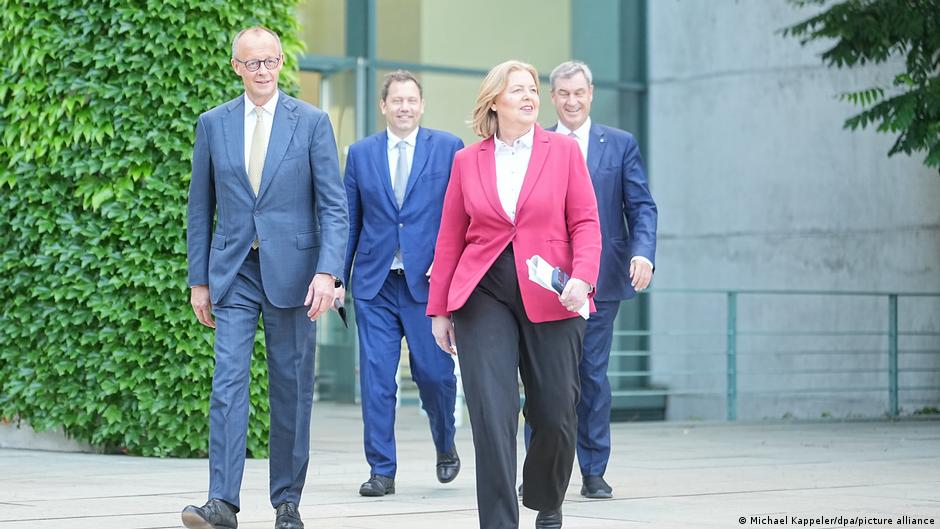
Friedrich Merz, Germany's Chancellor and leader of the conservative Christian Democratic Union (CDU) / Christian Social Union (CSU) bloc, declared that his party, alongside the center-left Social Democrats (SPD), had endorsed a "catalog of significant reforms." These measures, he stated, are intended to modernize the economy and enhance Germany's competitive standing on the global stage. Merz made the announcement at a press conference, accompanied by SPD leaders Bärbel Bas and Lars Klingbeil, as well as Markus Söder, the leader of Bavaria's conservative CSU. The four coalition leaders had convened in Berlin the day prior to finalize the details of their policy package.
Key Aspects of the Reform Package
The proposed reforms encompass several critical areas, including:
- Pensions: The government plans to implement the recommendations of the pension commission, which include introducing an investment-based component to Germany's predominantly pay-as-you-go state pension system. Additionally, the retirement age is slated for a gradual increase over the coming decades.
- Taxation: Households are set to receive approximately €10 billion ($11.4 billion) in annual tax relief. This relief will be partially financed by raising the top income tax rate from 45% to 47% for high-income earners.
- Labor: Reforms in the labor sector include discontinuing the ability for workers to obtain sick notes via phone. Medical certificates will now be required from the first day of illness. The package also grants businesses greater flexibility concerning fixed-term contracts and the dismissal of high-earning employees.
- Industry Support: Strategic industries, such as automotive, chemicals, pharmaceuticals, batteries, semiconductors, artificial intelligence, and clean technologies, are designated for government support.
- Welfare: Measures to combat benefits fraud will be strengthened through enhanced data sharing and more rigorous enforcement.
- Energy: Plans include accelerating the expansion of the electricity grid and providing clearer timelines for industrial grid connections.
- Trade: The government intends to reinforce EU anti-dumping and anti-subsidy mechanisms, increasing scrutiny of strategic non-European investments.
- Housing: A federal housing company will be established to support affordable housing initiatives and facilitate mortgage financing.
- Bureaucracy Reduction: Companies will see a reduction in forms and reporting obligations. Furthermore, some applications will be automatically approved if officials fail to act within four months.
Government Perspectives on the Reforms
Chancellor Merz emphasized the government's commitment to relieving the burden on employees and businesses through tax cuts and bureaucratic streamlining. "We have now completed our first year of reform. From the very beginning, we set an agenda serving a single goal: We want to get Germany moving again. It is now clear that this is possible," Merz stated. Facing pressure due to his party trailing in polls against the far-right Alternative for Germany, Merz is keen to demonstrate progress in invigorating Europe's largest economy, despite internal coalition challenges.
The other leaders of the coalition parties expressed strong support for the reforms. Lars Klingbeil, SPD co-leader and Finance Minister, voiced confidence that the reforms would garner broad public approval, particularly due to their emphasis on fairness. He asserted that the coalition had "agreed on solutions that can be supported by a broad majority of our society," believing these decisions would provide "new strength" to the nation. Bärbel Bas, another SPD co-leader, echoed this sentiment, stating that the package would "indeed ensure that the economy grows again, that we achieve growth and secure jobs, while maintaining social balance, and, above all, that we strengthen cohesion within our country." CSU leader Markus Söder characterized the package as "well-rounded," acknowledging that while each partner might have desired more in specific areas, "a coalition means compromise." He concluded that the package, though not a "big bang," represented a significant step away from economic stagnation.
Industry and Business Support
The reform package has been met with enthusiasm from prominent figures in the business community. Christian Sewing, CEO of Deutsche Bank, lauded the reforms as a crucial step towards restoring Germany's competitiveness. "This reform package is a very successful starting point and supports our call for reforms that promote growth, competitiveness and innovation," he remarked, urging the government to maintain momentum and pursue further reforms.
The German Insurance Association (GDV) also welcomed the measures, with Managing Director Jörg Asmussen stressing the importance of "swift and consistent implementation as part of the parliamentary process." Rainer Dulger, president of the Confederation of German Employers' Associations, hailed the package as a "long-overdue change of course," recognizing its potential to strengthen competitiveness and confidence. However, Dulger also called for additional measures, particularly concerning high social security contributions and a lack of relief for high earners.
Criticism from Labor Unions and Opposition
Conversely, the reform package has faced sharp criticism from labor unions and opposition parties. The Verdi services trade union expressed strong disapproval, particularly regarding the requirement for medical certificates from the first day of illness, viewing it as an "expression of a culture of mistrust." Frank Werneke, head of Verdi, argued that "mistrust toward employees and the expansion of the madness of fixed-term employment contracts do not create growth."
IG Metall, Germany's largest trade union, offered a more nuanced assessment, describing the package as a "mixed bag of light and shadow." While Christiane Benner, the union's chair, welcomed the planned tax relief for workers, she criticized the expansion of fixed-term employment contracts as an "attack on workers' rights" and opposed the abolition of telephone sick notes, calling it a fulfillment of employers' "antisocial wish list."
Political opposition also voiced concerns. Felix Banaszak, co-leader of the environmentalist Green Party, sharply criticized the package as a "vote of no confidence in citizens." The socialist Left Party condemned the reforms as a "program of mistrust and ignorance," arguing that "a few euros less in taxes do not compensate for higher living costs, insecure pensions, and rising burdens in the healthcare system." Family doctors also expressed dismay over the sick note proposals, with Markus Blumenthal-Beier, chairman of the German Medical Association, warning of "the complete overburdening of our doctors' practices," leading to a "massive wave of bureaucracy" and extended waiting times for patients.
Source: Original Article